Featured
SpaceX’s Starship Finds Success in 1st Orbital Flight, Earns NASA Praise
Written by: Space Foundation Insights Team
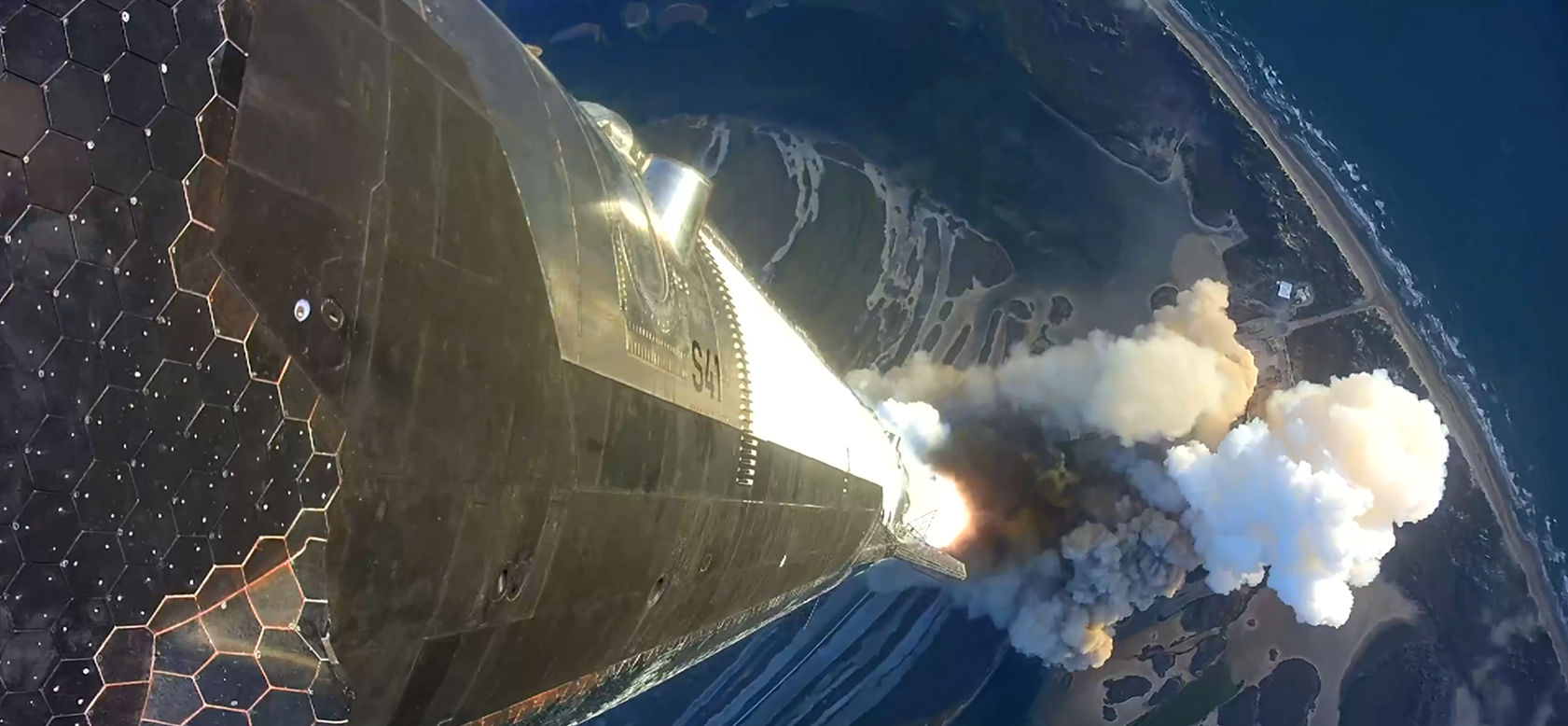 SpaceX’s Starship lifts off from Texas on its way to its first successful orbital flight. The machine can lift 100 tons to orbit.
Credit SpaceX
SpaceX’s Starship lifts off from Texas on its way to its first successful orbital flight. The machine can lift 100 tons to orbit.
Credit SpaceX The largest space launch vehicle ever constructed surpassed its biggest hurdle Monday as SpaceX’s Starship lifted off from Texas and reached orbit on its 14th test flight.
Starship, a 40-story launch vehicle capable of lifting 50 full-sized Ford pickups to space, is critical to NASA’s Artemis lunar plans.
The space industry has eagerly awaited Starship as a machine that can cut launch costs by orders of magnitude in the same way Boeing’s 747 jumbo jet created the concept of economy class flight in the late 1960s. Starship’s launch capacity promises to alleviate the current launch bottleneck and deliver unprecedented payload volume.
With the successful Starship launch, the U.S. space program has two super-heavy lift vehicles in various stages of development. Blue Origin’s New Glenn, a lighter class heavy-lift vehicle, launched two successful orbital missions in 2025. The same year Blue Origin announced a variant, the New Glenn 9×4, that will be a super-heavy vehicle. Blue Origin’s New Glenn heavy-lift and ULA’s heavy-lift Vulcan have been grounded following launch failures earlier this year. SpaceX also announced plans last month to wind down some Falcon 9 launches in favor of the Starship.
NASA’s Starship Plans
NASA Administrator Jared Isaacman praised SpaceX for the orbital achievement. “NASA along with the rest of the interested public is excited to help where we can and for Starship missions to become routine,” he wrote on X.com.
The agency plans to use Starship as a lunar lander and a cargo hauler as part of a U.S. plan to build a base on the Moon. But Starship’s development process has tested the faith of leaders.
Starship first flew in 2023, with a four-minute ride ending with a cataclysmic fireball that SpaceX described as “rapid, unscheduled disassembly.” Starship’s engineering team has faced flameouts, heat shield failures, and fueling issues in tests leading up to the orbital flight. Even Monday’s flight was not perfect. The Starship itself exploded upon splashdown in the northern Pacific Ocean, and its planned 10-hour orbit was shortened to three. Starship did successfully deploy 26 next-generation V3 Starlink satellites, which SpaceX reports will deliver a tenfold improvement in downlink capacity and 22 times the uplink capacity.
More Tests Planned
SpaceX plans to add complexity to its 15th test flight next month. It plans to land the booster and second stage on gantries. That would be a big step toward SpaceX’s goal to run Starship at pace and scale rivaling its reusable Falcon 9, the most-used booster on Earth in recent years.

Credit: Space Foundation
Of the 228 global orbital launch attempts into September, SpaceX’s Falcon 9 operated 47%. Rocket Lab was in second place with approximately 7% of total 2026 launches.
Starship’s two suborbital flight tests this year have seen it place its upper stage into orbital space and release test satellites before returning to Earth on a ballistic arc.
To the Moon
NASA plans to test Starship’s capabilities next year during its Artemis III flight to Earth orbit. There, astronauts in NASA’s Orion capsule plan to maneuver and dock with Starship. That will prove technologies needed for the Artemis IV Moon landing. SpaceX also is developing the Starship HLS lunar lander. HLS is competing against Blue Origin’s Blue Moon lander. The chosen lander will ferry astronauts to the lunar surface.
Related Articles