Global Space
Artemis III On Track for Triple-Launch in 2027
Written by: Jeff Gardner
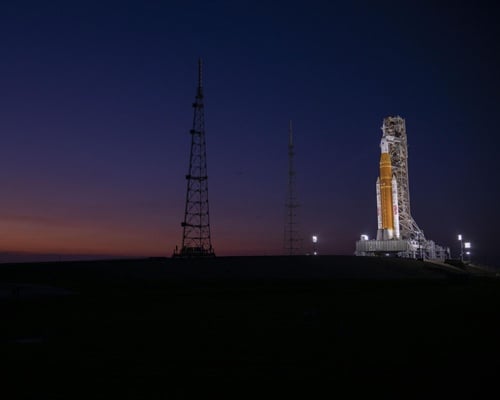 The Space Launch System at Kennedy Space Center ahead of the Artemis II launch. Credit: NASA
In less than a year, the Artemis III mission will test two landers to return humans to the lunar surface for the first time in more than 50 years. NASA’s Space Launch System (SLS), the same vehicle type that launched astronauts around the Moon earlier this year, is being prepped to send astronauts back into space. But that is not the only launch involved in Artemis III.
The Artemis III mission also will include SpaceX Starship and Blue Origin New Glenn launches and will test the two companies’ lunar landers in low Earth orbit (LEO). The mission is planned for summer 2027.
The 14-day mission will begin with a New Glenn launch to deliver Blue Origin’s Blue Moon lunar lander into orbit. NASA’s SLS will then launch the Orion spacecraft from Kennedy Space Center. Orion will rendezvous with the Blue Moon lander and conduct in-space testing. Then, Starship will launch to rendezvous with Orion. After docking and testing Starship’s Human Landing System, Orion will separate and return to Earth.
“We have a workforce that is hungry to build,” said NASA Associate Administrator Amit Kshatriya at an Oct. 23 press conference. “The ideas are important, the vision is important, but it takes courageous impatience… and that’s what our team is doing every day.”
Testing Landers for a Moon Landing
SpaceX and Blue Origin are planning uncrewed tests of their lunar landers on the Moon between the Artemis III and Artemis IV missions. If everything is successful, Artemis IV, the first human lunar landing since 1972, is planned for launch in 2028.
The Artemis update comes as NASA’s Aerospace Safety Advisory Panel has expressed concerns about the timeline and complexity of the Artemis IV mission. Its concerns hinge on what it describes as the landers’ insufficiently demonstrated landing and return capabilities, Starship’s unproven in-space refueling needs and the schedule pressure of testing and sending astronaut-crewed landers to the Moon in two years.
 “We are very much in a new space race,” said NASA Administrator Jared Isaacman. “Despite decades of accumulated knowledge and extraordinary advancements in technology, this race will be much closer than it ever needed to be.”
Lunar Logistics
NASA has partnered with more than a dozen American companies to develop and deliver technology to the Moon. The Commercial Lunar Payload Services (CLPS) program enlists companies to send robotic missions to the Moon to scout locations, test experimental instruments, and lay the foundations for the Moon Base.
“When American astronauts do take their first steps on the lunar surface in 2028, a rover and the first elements of an enduring human presence on the Moon will already be waiting for them,” Isaacman said.
The proposed Moon Base will be constructed in three phrases. Phase one, from 2026 to 2029, would see 21 lunar landings secure reliable access to the lunar surface. The second phase, from 2029 to 2032, would involve 27 landings to establish the base’s initial operations. Phase three, planned for after 2032, includes 28 landings and a semi-permanent human presence. Each phase will cost an estimated $10 billion.
Peaks and Valleys
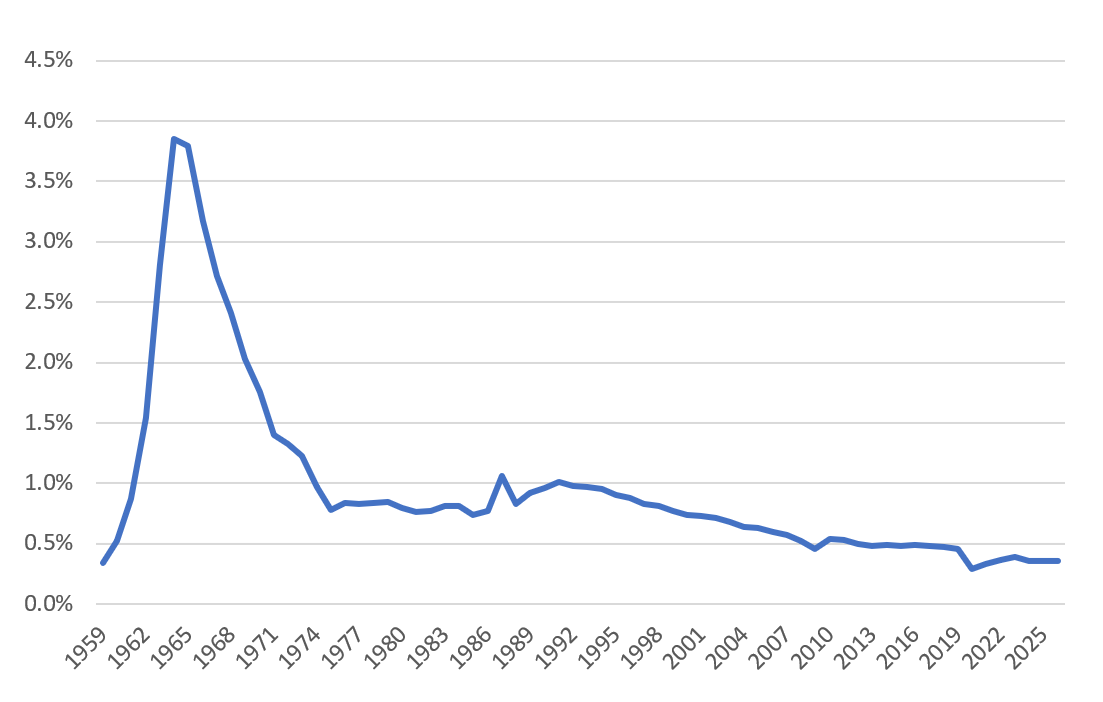
NASA’s budget as a share of the overall U.S. federal budget, 1959 – 2026. Source: Space Foundation
Today’s space industry is very different from when NASA last sent humans to the Moon. In the mid-1960s, when the Apollo program experienced peak funding, NASA’s budget comprised nearly 4% of the U.S. federal budget. That funding rapidly declined toward the 1970s. Today, NASA’s share of the federal budget is at an all-time low, at roughly 0.4%. That low still adds up to more than $24 billion in 2026.
NASA is facing major potential budget cuts. In 2025, the Trump administration proposed slashing the agency’s funding by nearly 25% for FY2026, down to $18.8 billion. Congress rejected the proposal, instead voting to approve a continuing resolution that maintained funding at $24.4 billion. The Trump administration has again moved to reduce funding to $18.8 billion for FY2027. The reduction could slash NASA’s science program funding 47%. Congress is next expected to act on NASA’s budget in December.
Related Articles