Public Policy and Government Affairs
Fiscal Cliff Looms for Federal Space Spending Amid Budget Delay
Written by: Tom Roeder
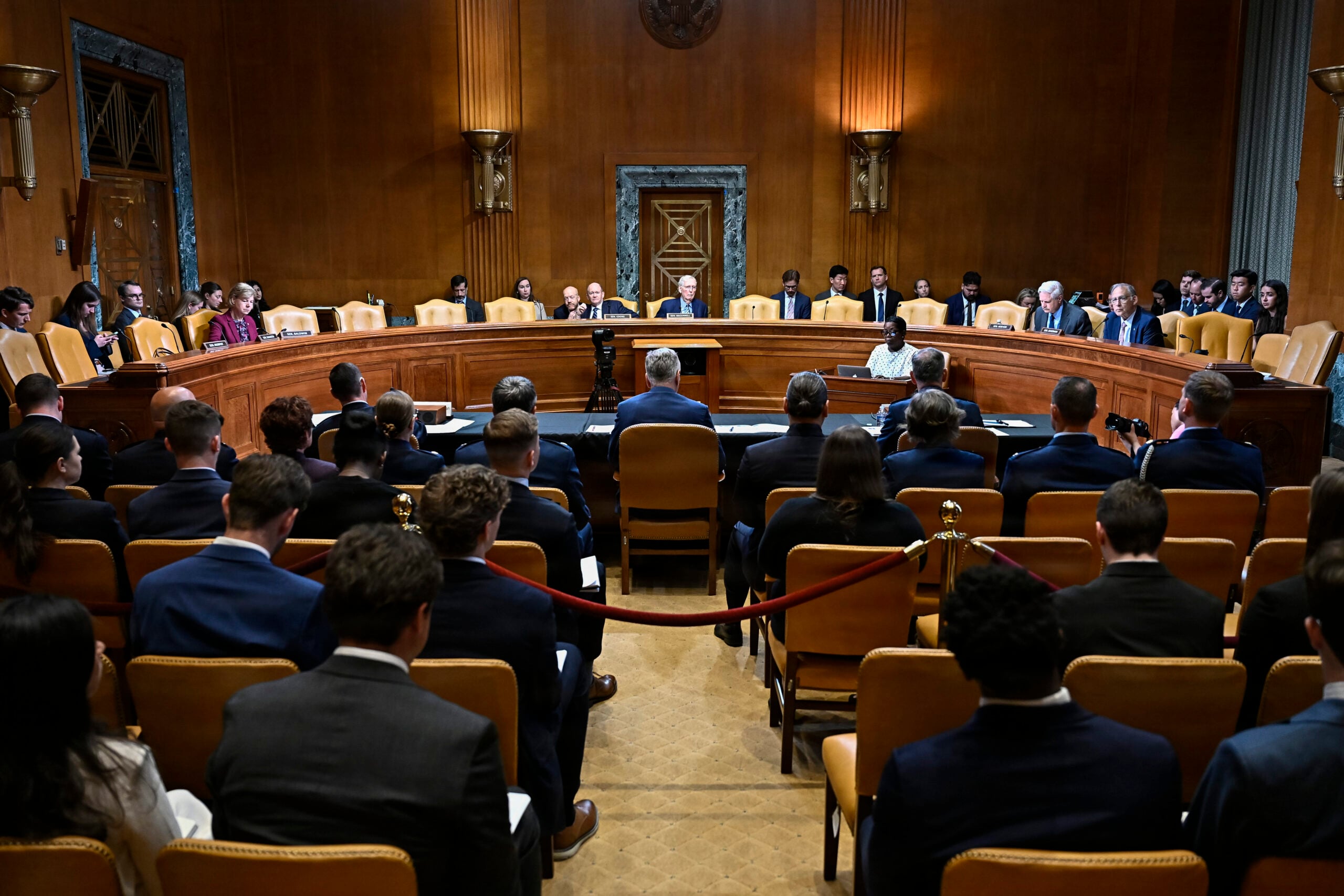 Air Force Chief of Staff Gen. Ken Wilsbach, center right, Secretary of the Air Force Troy Meink and Chief of Space Operations Gen. Chance Saltzman testify during a budget hearing before the Senate Appropriations Defense Subcommittee on Capitol Hill in Washington, D.C., June 9, 2026.
Air Force Photo
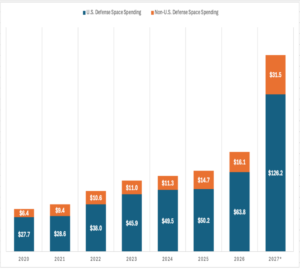
*Projected 2027 spending
Note: Global military space spending estimates are derived from public budgets and estimates using established formulas to calculate spending. The nations with public budgets for 2027 included Nigeria, Brazil, Japan, France, Germany, Russia, and Spain.
Credit: Space Foundation database
Congressional gridlock ahead of the midterm election paused plans to nearly double national security space spending to as much as $126 billion. Now Pentagon programs remain in limbo as a Dec. 11 federal shutdown looms.1
The cloudy horizon comes after a sunny year for military and intelligence satellite programs. The House and Senate made steady progress on a measure to boost military spending by half to $1.5 trillion and .
The budget would replenish weapons expended in combat with Iran and build industrial capacity across the defense sector. It would also drive research and development, with space systems alone getting a $40 billion in research funds.2
Space Force leaders have decried short-term budget bills in the past, including a yearlong measure that kept military spending flat in 2025. Air Force Secretary Troy Meink warned in September that short-term budgets delay long-term plans for the Space Force.
“In today’s rapidly changing threat environment, we cannot expect a world-class military if we choose not to invest in it,” Meink stated.3
Space Security Shutdown
If Congress fails to reach a budget deal ahead of Dec. 11, a shutdown would put much of Space Force’s civilian workforce on furlough.
Civilian furloughs impact Space Force harder than its sister services because the civil service accounts for just over a third of the service’s total employment. Portfolio Acquisition Executives, a Trump Administration effort that fast-tracks purchases for satellites and ground gear, rely on civilian expertise.
“We continue to overhaul our acquisition structure to strip away bureaucracy,” Gen. Doug Scheiss, the Chief of Space Operations, said in September.7
Over the past year, President Donald Trump has raised the profile of the Space Force, a service he founded during his first term.
In December he signed an executive order “Ensuring American Space Superiority.” Trump assigned the Pentagon responsibility for security in cislunar space from the edge of Earth’s atmosphere to the surface of the Moon. The order previewed priorities made clear months later when the Pentagon’s 2027 spending plan was released, allotting the Space Force $71 billion.4
Space Spending Cap: $5 Billion Monthly
For now, the Pentagon is capped at about $5 billion a month for space spending through the Dec. 11 budget deadline set for Congress. The proposed 2027 budget would increase space spending across the armed services and intelligence community to an estimated $126 billion. That’s up from an estimated $63 billion in 2026.5
The federal budget last ran aground in 2024, with six months of rolling delays leading to a yearlong temporary budget that operated government at 2024 spending levels through Oct.1, 2025.6 At the time, Space Force leaders complained that the flat budget hampered cutting-edge research programs and blocked leaders from pursuing new programs. The latest budget delay comes as the Space Force opens the throttle on its new streamlined acquisition system.
In an interview, retired Space Force. Lt. Gen. John Shaw compared the money flowing to and from the Pentagon as the traffic on a major freeway. If everything goes to plan, there’s no problem.
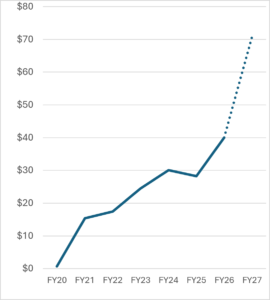
Space Force’s annual budget has risen sharply, but the planned 2027 increase is the largest in its history.
Credit: Space Foundation database
As for late budgets, “It’s like a multi-car pileup,” he said.8
Plans on Hold
The latest budget delay comes as Space Force Guardians await the flight of a new generation of satellite sensors, satellite communications, and navigation. One notable new constellation is the Airborne Moving Target Indicator, an early warning and tracking spacecraft that could spot enemy aircraft and missiles in flight and deliver telemetry to intercept the weapons to forces on the planet.9
Other notable programs on hold include a new generation missile warning satellites that spot the heat of rocket launches and a new constellation of communications satellites to augment existing systems. The new satellites are part of a major shift to add smaller, mass-produced satellites in low Earth orbit to augment older and-built spacecraft the service began placing the geosynchronous orbit since the Cold War.
Another change sought for 2027 would grow the ranks for Space Force by 2,400 Guardians to 13,200. Space Force leaders have said they need more Guardians to cover the growing roles of the service. The budget would also boost Space Force spending for intelligence and communications capabilities available on the commercial market, with $1.5 billion earmarked commercial communications satellite deals.
Competitors Projected to Track U.S. Spending
China and Russia, the largest spacefaring nations outside the United States, have traditionally tracked U.S. spending, increasing their budget when U.S. spending goes up but never matching the U.S. dollar-for-dollar.
But the larger U.S. budget comes as global spending on military space programs is expected to double in 2027 to $31.5 billion.10 Now, more nations are beginning to embrace state-run and cooperative space programs, with nations including NATO powers along with Japan and South Korea planning to field sovereign space capabilities by the 2030s.11
In the western Pacific, Taiwan joined the space chase, with plans for communications and Earth observation satellites. Leaders there say space capabilities offer deterrence that could calm tensions in the region.
“We are increasing investment in defense because we are alert to threats that are greater than ever before ¾ this is not to provoke, but to prevent war,” Taiwan’s President Lai Ching-te stated in a May.12 “We are enhancing our self-sufficiency in national defense not to escalate conflict, but to protect our people.”
What About NASA?
For NASA, the continuing resolution isn’t a big fiscal hit. The agency expected cut in the 2027 budget, with the White House carving as much as $6 billion from its 2026 spending plan. The continuing resolution keeps NASA funding flat at $24.4 billion, matching budget numbers that were approved for FY27 by House and Senate committees.
—
1 Space Foundation “Congress Avoids Government Shutdown Ahead of Midterms” Sept. 1, 2026. https://www.spacefoundation.org/2026/09/01/congress-avoids-government-shutdown-ahead-of-midterms/
2 Space Foundation Database GSE26 Defense Space.
3 Air Force. “Meink offers blueprint for modernizing Air, Space Forces ‘affordably’” Sept 14, 2026. https://www.af.mil/News/Article-Display/Article/4600887/meink-offers-blueprint-for-modernizing-air-space-forces-affordably/
4 Homeland Security. “Fiscal year 2027 budget in brief.” April 27, 2026. https://www.dhs.gov/publication/fiscal-year-fy-2027-budget-brief.
5 Space Foundation Database GSE26 Defense Space.
6 Congress “HR-1968” March 15, 2025. https://www.congress.gov/bill/119th-congress/house-bill/1968.
7 Gen. Douglas Scheiss. “Remarks” Sept. 15, 2026. https://www.spaceforce.mil/News/Article-Display/Article/4602018/remarks-by-cso-gen-douglas-schiess-at-the-air-and-space-forces-associations-202/.
8 John Shaw interview. Oct. 19, 2026.
9 Space Systems Command Space Force Accelerates Fielding Space-based Airborne Moving Target Indicator. May. 29, 2026. https://www.ssc.spaceforce.mil/Newsroom/Article-Display/Article/4503728/us-space-force-accelerates-fielding-space-based-airborne-target-indicator-progr
10 Space Foundation. “Global Space Economy” https://www.spacefoundation.org/events/global-space-economy/#GSEN-updates.
11 Space Foundation database. “Defense Space Select Nations.
12 Office of the President of Taiwan. “President Lai delivers address on second anniversary of taking office.” May 20, 2026. https://english.president.gov.tw/News/7141,
Related Articles