Uncategorized
Midterm Shakeup Casts Doubt on Future Military Space Spending
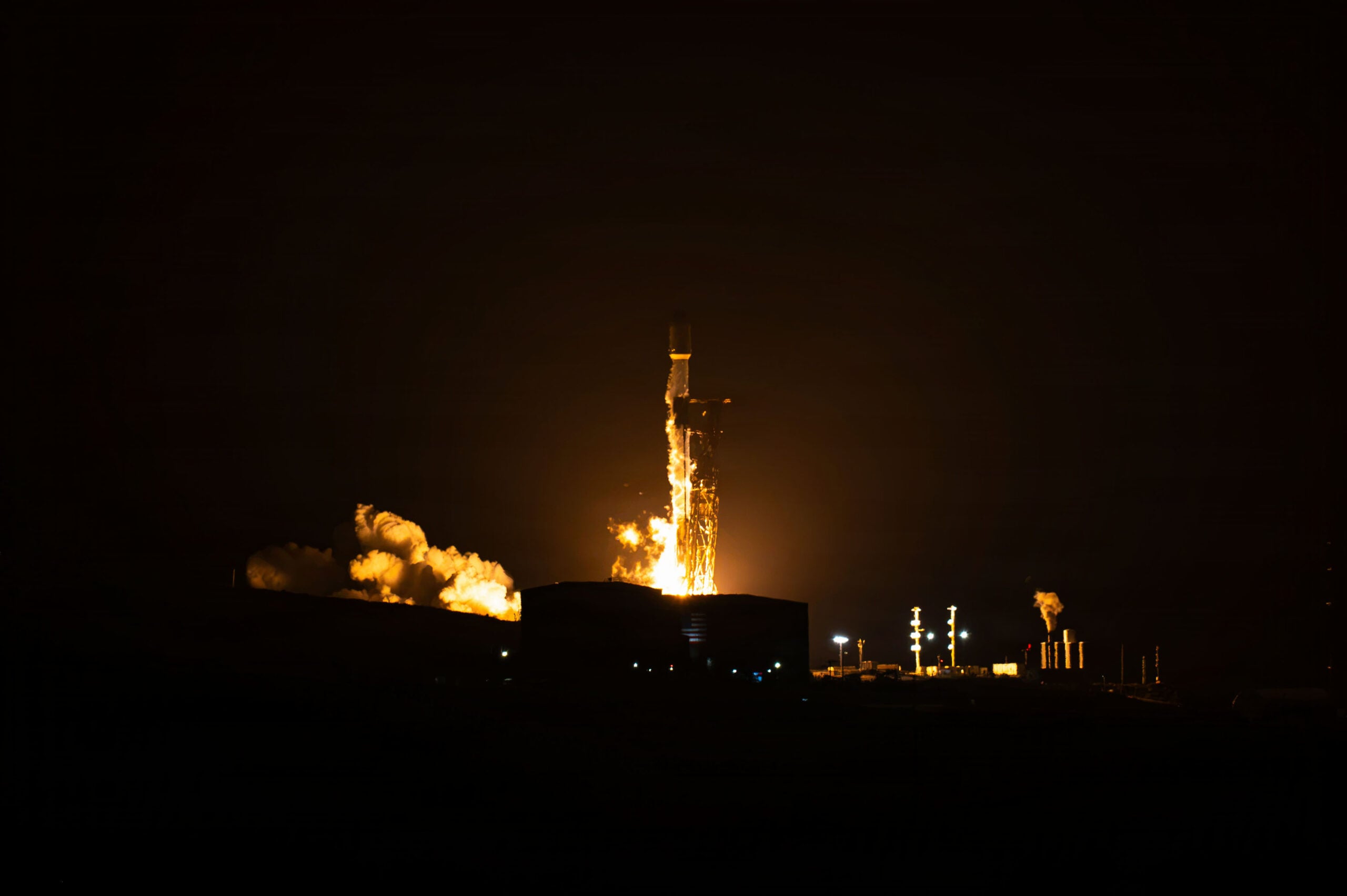 A record 72nd orbital launch lifts off from Vandenberg Space California on Oct. 27, making it the busiest launch year in the base’s history.
Credit: Space Force
With Democratic majorities in the U.S. House and Senate certain after the Nov. 3 midterms, a new set of legislative leaders who take office in January will decide the future of federal space spending, national security priorities and the pace of civil and military space programs.
How Democrats will wield power and whether the last battle of Republicans can push through budgets for NASA and the Pentagon before they give up their gavels are questions yet to be answered.

President Donald Trump announced the Golden Dome initiative from the Oval Office in 2025. With Democrats poised to control the 120th Congress, some lawmakers already are saying its budget costs will likely be a target for cuts.
Credit: White House
The first test will come this month as lawmakers consider the largest Pentagon budget ever proposed at $1.5 trillion including the doubling of national security space spending to an estimated $126 billion.[1] Space Force spending would increase $30 billion to more than $71 billion under the prosed budget, and another $18 billion would go to a national Golden Dome.[2]
Republicans have a last chance to get a budget through as the 119th Congress concludes. A continuing resolution keeping government open is set to expire Dec. 11.
What isn’t done by Jan. 3 will fall to the incoming Democratic leaders, who won control of the 120th Congress by holding safe seats and contesting Republicans in GOP strongholds including Texas and South Carolina.
While the midterm performance gives Democrats committee chairmanships, it also gives the party the same problem Republicans have faced while in power: The need to assemble 60 votes to push legislation through the Senate, which requires bipartisan dealmaking. Democrats in January are poised to be a few votes short of 60, just as Republicans in the 119th Congress are.
Some national security leaders see gridlock ahead. President Donald Trump responded to the election with an olive branch and a veto pen.
“Look, I’ll get along, probably with the Democrats, unless they want to be destructive, but I have the power of the veto” Trump said Wednesday.[3]
Clayton Swope, deputy director of the nonpartisan Center for Strategic and International Studies, said the Pentagon’s 2027 plans are fading. “It feels like it was a fairy tale.”[4]
Former Air Force Secretary Frank Kendall said the military and intelligence agencies probably won’t get the proposed increases for FY27. He

Frank Kendall
predicted lawmakers would likely to extend the 2026 budget with a continuing resolution, which would keep spending flat for the Pentagon. Congress has long used continuing resolutions as a fix for partisan gridlock. In 2025, military leaders complained that continuing resolutions hamper readiness and research.
“Reality may be another yearlong (continuing resolution),” he said.
The 2027 federal budget as proposed would grow the federal deficit by as much as $1.8 trillion.[5] The federal debt sat at $40.5 trillion in the days leading up to the election, a figure that has doubled in a decade. The debt, swollen by increased interest payments expected to top $2.1 trillion this year, was an issue the drew attention on the campaign trail.[6]
If lawmakers decide to cut spending, the Pentagon’s proposed 2027 budget, with a $1.15 trillion annual allocation augmented by $350 billion in one-time money, would be the first target. Lawmakers have few options for cuts elsewhere, because proposed national security programs account for 75% of discretionary spending in the 2027 plan.
Congress in the past has shown reluctance to cut Pentagon spending. The Pentagon has faced six cuts in 25 years, with smaller budgets
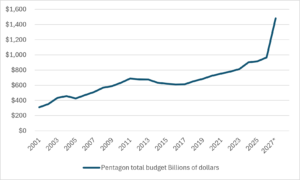
Pentagon budgets 2024-2027 (proposed)
Source: Space Foundation
usually coming after a midterm election. The cuts have been relatively small, and the lost billions didn’t stall a wider trend that tripled U.S. military spending since 2001.[7]
Most military space programs still enjoy bipartisan support, and the Space Force got more than $40 billion included in the 2026 budget. Swope said the Space Force is poised for more money even if other branches take a hit, because its latest programs are considered vital to address existing threats.
“We are still looking at a record Space Force budget,” Swope said.

Clayton Swope
Swope said the most likely scenario would see the new Congress set a maximum number for military spending, with the Pentagon making trade-offs to fit the budget.
“That trickles down to a topline number for the Space Force,” he said.
The Council on Foreign Relations on Wednesday stated that Republicans will need to move quickly and peel away Democratic votes in their final session if they want to push for bigger budgets and save favored.[8] The projects include Golden Dome missile defense effort. Another Trump priority is a Navy upgrade dubbed Golden Fleet that would include vessels the size of World War II battleships carrying a missile arsenal.
“This is not just a question of locking in a higher defense budget than what a Democratic majority might support,” the think tank stated. “Once the new Congress is sworn in, Democrats will likely take shots at specific Trump defense priorities they view as ineffective or wasteful, such as Golden Dome or the Golden Fleet.”
Getting Congressional support for missile defense may require dumping the politicized Golden Dome moniker, Swope said. The name originally was Iron Dome for America, but the White House swapped gold for iron.
The Brookings think tank reached the same conclusion, adding in a Navy fleet revitalization that got a golden title. “The Golden Dome missile defense system and Golden Battleship would get no big chunks of financial support absent detailed plans and substantial debate.”[9]
To get any pet projects through before the new Congress convenes, Republicans would need Democratic votes in the Senate, where 60 votes are required to end debate and move legislation to a floor vote.
What’s at Risk?
When defense budgets are cut, lawmakers usually pursue low-hanging fruit. Typical targets include programs funded with one-time

Soldiers in New Mexico train with a Patriot missile system in 2026. Patriot can shoot down incoming ballistic targets.
Credit: Army
appropriations, programs the military wants to jettison, and programs with large, planned budget increases. Here are some examples:
Golden Dome, $18 billion in FY27
Congress invested $47 billion in one-time money in 2025 to develop a global missile shield. Cost estimates have soared for the program, which includes new space-based sensors, communications satellites, and space-based interceptors. The Pentagon request for FY27 included another $18 billion in one-time expenditures. The military has stated the system could be ready for limited operations as soon as 2028. Even with large contracts and commitments, Golden Dome would be an easy target for cost-cutting because the whole program has been financed with one-off appropriations, money from supplemental measures outside the military’s budget.
Some lawmakers have expressed alarm over some Golden Dome cost estimates. The Pentagon has put the program’s price at about $150 billion, while the Congressional Budget Office stated the price could top $1.2 trillion over 20 years and require as many as 7,800 satellites to intercept a limited attack of 10 intercontinental ballistic missiles[10]
The Missile Defense Agency in late 2025 announced tentative contracts with 1,014 companies for Golden Dome work. The states with the most to lose if Golden Dome faces cuts include California, Virginia, Texas, Alabama, and Colorado.
Recent combat in Iran showed the need for improved air and missile defense, with sea, air and land assets saturated by incoming fire, which allowed Iranian missile and drone strikes to hit U.S. and allied targets in the region.
Polar Overhead Persistent Infrared, $500 million

A satellite designed to spot Arctic missile launches could be cancelled if budget cuts hit.
Credit: Northrop
Space Force leaders eliminated development money for the missile warning satellites in the service’s 2027 budget request. Most members of Congress have been eager to back the project, which would detect missiles fired in Arctic regions. Republican leaders on the House and Senate armed services committees added as much as $500 million for the satellites in spending plans that await floor votes.
The polar problem has existed since the Cold War. Launches from extreme latitudes can be difficult to spot to traditional sensors like the Defense Support Program satellites that float in geosynchronous orbit at the equator That positioning can make spotting launches in Arctic latitudes difficult. The new system would put satellites use an elliptical orbit to keep constant watch on the pole.
The satellite program has gotten support from Democratic administrations as a way to safeguard the United States from threats in North Korea, China and Russia, which could fire missiles over the pole to strike U.S. targets.
Military leaders have called for mothballing the program as new sensors are bult for Golden Dome. While the small program accounts for just 0.3 percent of the budget, it could be the first cut supported by the Pentagon if Congress decides to downsize 2027 spending.
States that could be impacted by cuts to the polar satellite program include Virginia, Florida, California, and Colorado.
Research and Development, $40 billion
The largest American space research investment ever planned lies within Space Force’s 2027 budget request. Research and development programs account for $40 billion of the Space Force’s $71 billion budget request. That’s more than the service’s entire 2027 budget. Space Force would use the money to develop new battlefield communications systems, deliver new sensors for missile warning, and build a space-based “moving target indicator,” which could spot planes, missiles, and drones The moving target indicator has big support in Congress because it could be used to build a global picture of military operations and repel missile drone attacks, which have caused havoc in the Persian Gulf. While it could support Golden Dome, the program is placed in the Space Force’s main budget, a move to ensure a steady funding flow.
Much of the Space Force’s research money is going to classified programs. A deep research cut would have wide impact, with Maryland, Ohio, Michigan, New Mexico, and New Jersey taking a hit alongside bigger space states such as California and Colorado.
Trump Supports Service Founded in First Term
The Space Force has made a strong case for a bigger budget this year, with missile warning, GPS, space-based communications, and intelligence satellites playing a key role in the still-smoldering Iran war.[11]
Adm. Brad Cooper, U.S. Central Command’s top officer, said satellites served as a critical enabler for U.S. and allied forces in the Middle East. Satellites allow precise strikes on defined targets and give critical warnings to the military and civilian population facing Iranian retaliation.
In 2025, Trump’s second term brought a $10 billion boost to Space Force’s budget along with seed money for Golden Dome and increased funding for classified space capabilities. The administration also added $4 billion to help fund improvements at Florida’s Cape Canaveral Space Force Station and Vandenberg Space Force Base.[12] Leaders across military, civil, and commercial space sectors have feared aging infrastructure would fail under the record launch boom, which has spiked since 2021.[13]
Since his return to the White House, Trump has rewritten much of spaceflight rulebook with series of executive orders. Topics include: Building Golden Dome, promoting commercial competition in space, building nuclear propulsion for space, establishing military space dominance, constructing a lunar base, creating a federal academy dedicated to military and civil space, lifting regulatory hurdles for space operators, and opening more spaceports for military, civil and commercial launch.[14] The orders impact federal agencies, but don’t carry the force of law and weren’t subject to a vote in Congress.
While the growth of Space Force’s budget might be slowed by a new Congress, the service is unlikely to face cuts below its $40 billion 2026 budget, experts say. Rising threats in orbit, robotic warfare on Earth and a global push for sovereign space capabilities make space a key issue.
New military space programs are rising from east Asia and the Middle East to Europe and Canada. Allies and rivals are expected to double space spending in 2027 to $31.5 billion.
Space Force Makes its Case
Promoted to the top post Sept. 3, Chief Space Officer Gen. Douglas Schiess, the Space Force’s third commander, has since spent a

Chief of Space Operations Gen. Douglas Schiess testifies during a July 16 Senate hearing.
Credit: Space Force
considerable amount of time touting the service’s long-term plans and financial requirements.
Two of those requirements are increasing needed personnel and building new facilities, he said.
Pentagon plans would grow the Space Force by 2,400 Guardians in 2027 to 12,800. Space Force has also asked for redundant operations centers, with new facilities in Colorado, New Mexico, and North Dakota. More Guardians would allow the service to control more satellites in orbit, and the operations centers would give an extra level of security to Space Force infrastructure, ensuring steady command of satellites even if a base is attacked.[15]
At $5.5 million for each Guardian in uniform, Space Force’s proposed $71 billion proposal looks massive As part of the larger Pentagon budget, it would consume 5% of defense spending, Democrats have pledged to examine every dime.
Washington state’s U.S. Rep. Adam Smith, the highest-ranking Democrat on the House

U.S. Rep. Adam Smith
Armed Services Committee, made it clear Wednesday that Congressional Democrats want a slimmer Pentagon budget.
“We must push for the development of a more realistic and sustainable approach to our national security,” he said. “One that does not require a defense budget in excess of $1 trillion or one paid for with draconian cuts to critical domestic programs.”[16]
[1] Congressional Budget Office. “An Analysis of Spending Proposals in the President’s 2027 Budget.” June 1, 2026. https://www.cbo.gov/publication/62546.
[2] Treasury Department. “National Debt. Oct. 30, 2026. https://fiscaldata.treasury.gov/americas-finance-guide/national-debt/.
[3] The White House. “President Trump Delivers Remarks, Nov. 4, 2026.” Nov. 4, 2026. https://www.whitehouse.gov/videos/president-trump-delivers-remarks-nov-4-2026
[4] Council on Foreign Relations. “Democrats Win Control of Congress. Here’s How That Could Affect U.S. Foreign Policy.” Nov. 4, 2026. https://www.cfr.org/articles/democrats-win-control-of-congress-heres-how-that-could-affect-u-s-foreign-policy.
[5] Brookings. “The midterm effect: What the 2026 election could mean for public policy” Oct. 22, 2026. https://www.brookings.edu/articles/the-midterm-effect-what-the-2026-election-could-mean-for-public-policy/.
[6] Congressional Research Service. “Golden Dome” Aug. 18, 2026. https://www.congress.gov/crs_external_products/IF/PDF/IF13264/IF13264.4.pdf.
[7] Congressional Budget Office. “Potential Costs of a National Missile Defense System” May 12, 2026. https://www.cbo.gov/publication/62379
[8] Adm. Brad Cooper. “Update” March 31, 2026. https://x.com/CENTCOM/status/2038966187640430937.
[9] Congress. “House Resolution 1” July 4, 2025. https://www.congress.gov/bill/119th-congress/house-bill/1
[10] Space Foundation database.
[11] The White House. “Executive Orders” Undated. https://www.whitehouse.gov/?s=executive+orders.
[12] Congress. “National Defense Authorization Act” May 13,2026. https://www.congress.gov/bill/119th-congress/house-bill/8800.
[13] Adam Smith. Email to Author. Nov. 4, 2026.
Related Articles