Featured
How the Artemis II Mission Lifted 6 Million Pounds Into Space
Written by: Jeff Gardner
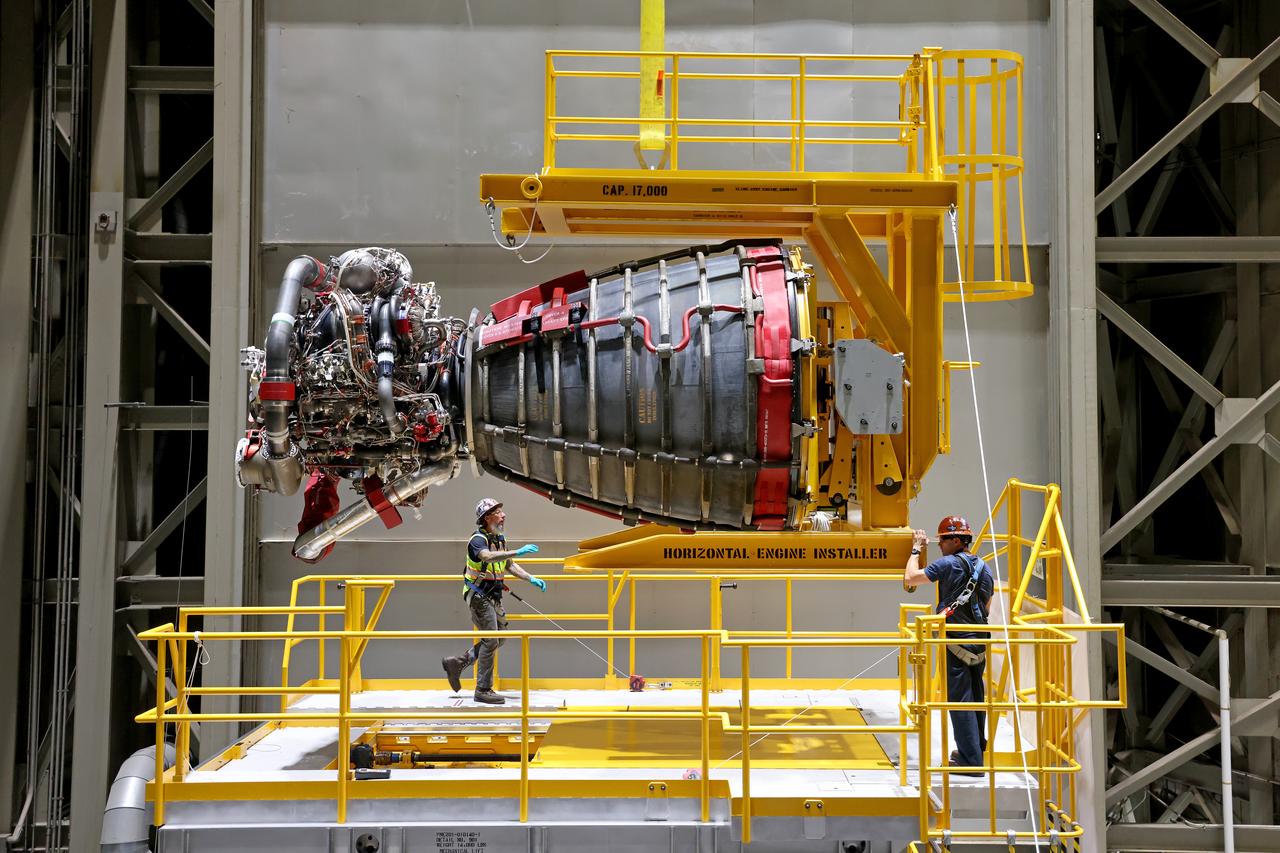 With improved RS-25 engines, L3Harris is targeting a 30% cost reduction from the engines that flew on the space shuttle. The engines also feature the latest in advanced manufacturing techniques, including 3D printing. Photo Credit: (NASA/L3 Harris)
 When a launch vehicle the size of Artemis II takes off, the roar shakes everything around it for miles. The brightness of the flames burns like the sun. This fusion of spectacle and science is sending humans toward the Moon for the first time in more than half a century.
In just a few days, the four astronauts of the Artemis II mission will reach a point in space farther than anyone else has ever traveled — nearly 250,000 miles from home. At the base of this historic mission are four rocket engines working to lift the 6-million-pound craft.
NASA’s Space Launch System (SLS) is equipped with four RS-25 engines originally designed to power the space shuttles. That program used RS-25 engines to launch 135 missions over the course of three decades. To lift the SLS, more power was required.
Improved Performance to 109% Rated Power
For use in the Artemis program, L3Harris engineers updated computer controls and associated software, and also added insulation because the RS-25 engines are closer to the booster exits on SLS than with the space shuttle. Paired with twin solid rocket boosters, Artemis II produced 8.8 million pounds of thrust, the most ever produced by a launch vehicle on a crewed mission.

Helen Lewis – L3Harris
“During the shuttle, we operated at 104% of rated power level at the end of the program,” said Helen Lewin, RS-25 Launch Support Lead at L3Harris. “Now, we’ve boosted it up to 109. These engines are amazing.”
These workhorses can withstand temperatures from negative 400 degrees Fahrenheit to up to 6,000 degrees Fahrenheit. The pressure achieved during launch exceeds 7,000 pounds per square inch.
Like the Crew, 3 of 4 Have Been to Space
The SLS core stage is equipped with 537,000 gallons of liquid hydrogen and 196,000 gallons of liquid oxygen. The engines consume 1,500 gallons per second. The energy produced by just one of these engines could power nearly a million miles of residential streetlights. And all of this happened in less than 10 minutes as Artemis II blasted into space.
There is a unique similarity between the RS-25 engines and the Artemis II crew. In each group, three members have already traveled to space while one is on its first voyage. Three of these engines previously flew in the space shuttle fleet, with one supporting 15 flights. The fourth engine, now on its initial voyage, was built during the shuttle years but never went to space.
NASA Administrator Jared Isaacman announced in February 2026 a major overhaul to the Artemis program. This pushed the crewed lunar landing from Artemis III to IV, allowing for more time to test a commercial lunar lander. However, the new mission architecture increased the cadence of lunar landings, with two crews now planned to step on the Moon in 2028.
L3Harris is supporting the Artemis II mission with more than 100 separate elements, including the RS-25 engines, the RL10 engine for the Interim Cryogenic Propulsion Stage and the Orion Main engine for the translunar injection burn. L3Harris also supplied in-space thrusters for course corrections, 40 advanced avionics systems for precision control and monitoring of the launch vehicle and the Orion audio system for continuous astronaut communications.
L3Harris workers have completed the engines for Artemis III and IV, and are working on engines for Artemis V.
“We’re not at all concerned about upping the engine production cadence,” Lewin said. “That is a challenge we’re absolutely ready to accept.”
Related Articles