Featured
Artemis II Sets Distance Record and Names Craters During Science Survey
Written by: Tom Roeder
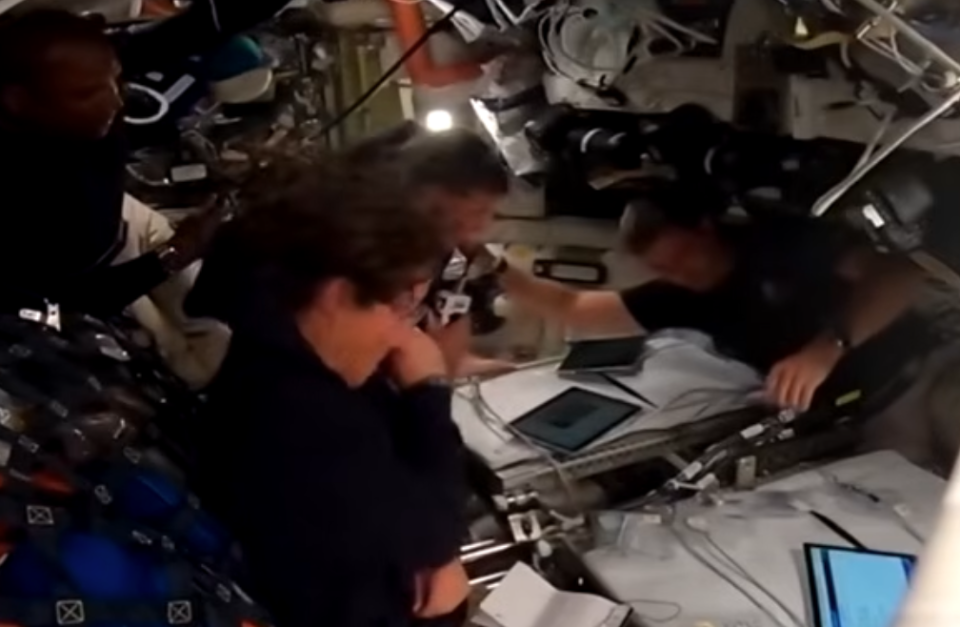 As astronaut Jeremy Hansen talked to Mission Control about naming a crater after Commander Reid Wiseman’s late wife, Wiseman and the rest of the Artemis II crew reacted. (Credit: NASA)
 Astronauts aboard Artemis II became the first humans to fly more than 250,000 miles from Earth just before noon on Monday as their Orion crew capsule passed the Moon on a figure-8 flight back to Earth, where they are expected to splash down off the California coast on Friday.
Artemis II surpassed Apollo 13’s record of 248,655 miles from Earth set in 1970 as the Orion spacecraft accelerated to nearly 25,000 mph for its return to Earth, NASA confirmed Monday. After setting the distance record, the crew continued lunar reconnaissance, targeting 30 locations on the Moon for observation, including the 400-mile-wide Orientale Basin crater, known as The Grand Canyon of the Moon. Monday was the first time any human had seen the basin in daylight, NASA officials said. The Artemis II crew sent back stunning pictures of the Moon before entering a blackout period, with the Moon blocking communications with Earth stations for more than 30 minutes.
Apollo 13’s Lovell Honors the New Record
The distance record was lauded in advance by Jim Lovell, who, along with his crew, flew past the Moon on the 1968 Apollo 8 test flight and set a record 248,000 miles from Earth on the famed Apollo 13 flight, where the crew fought to bring a damaged capsule back to Earth after a lunar flyby. Lovell, who died Aug. 7, 2025, recorded a wakeup call for the Artemis II crew that was played for them by controllers at Houston’s Johnson Space Center.
“Welcome to my old neighborhood,” Lovell said. “When Frank Borman, Bill Anders, and I orbited the Moon on Apollo 8, we got humanity’s first up-close look at the Moon and got a view of the home planet that inspired and united people around the world. I’m proud to pass that torch on to you — as you swing around the Moon and lay the groundwork for missions to Mars.”
Honoring an Astronaut’s Wife
Monday also brought the most poignant moment of the mission as Canadian astronaut Jeremy Hansen notified Mission Control the Artemis II crew wanted to suggest two names for unnamed craters. The first they wanted to name Integrity after their crew module. As Hansen began to explain the name for the second, his voice began to tremble. “A number of years ago in our close-knit astronaut family, we lost a loved one,” he explained. Artemis II Commander Reid Wiseman lost his wife, Carroll, to cancer in 2020, leaving him to parent their daughters, Katie and Ellie.
As Hansen spoke, Wiseman wiped away tears, but he then put a hand on one of Hansen’s shoulders as Hansen’s voice began to waver. Astronauts Christina Koch and Victor Glover joined the two in a floating embrace as Mission Control confirmed receiving the names.
Artemis II Shares Science Observations
The crew was expected to have seven hours to observe the lunar surface of the far side of the Moon, when the Integrity capsule would be 4,070 miles from the surface, its closest proximity. A science team on Sunday sent the crew a final list of 30 lunar surface targets for observation. Two sites of interest were the future CLPS landing site Reiner Gamma, a bright swirl that scientists are still trying to understand, and Glushko, a bright, 27-mile-wide crater known for the white streaks that shoot out from it for up to 500 miles.
Koch shared that two of the astronauts at the window could see the Earth and the Moon at the same time.
“It’s interesting because the Earth looks way brighter,” she said. “So the Earth itself seems to have a much higher albedo than the Moon.” Albedo is a measure of how much sunlight a surface reflects into space rather than absorbing it.
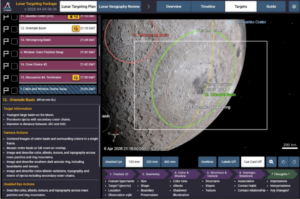
A screenshot of the Lunar Target Application that guided Artemis II astronauts through lunar observations. (Credit: NASA)
Related Articles