
Space Foundation News
‘Throttle Up’ Takes on New Meaning for L3Harris Engineer Supporting NASA’s Artemis Missions
Written by: Space Foundation Editorial Team
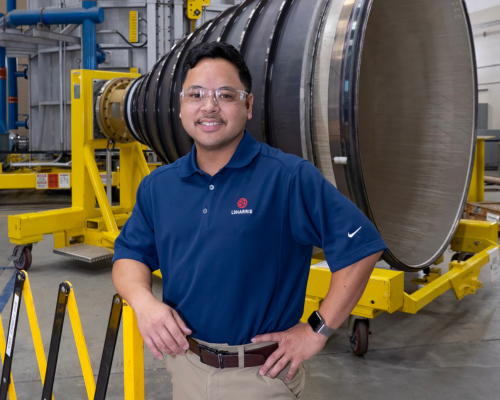 Mark Aldaba stands near the nozzle for an RS-25 engine. Credit: L3Harris
 From the Garage to the Moon
A couple of decades ago, Mark Aldaba was working on machines that only left the surface of Earth when something went horribly wrong. Those custom motorcycles and hot rods couldn’t hold a candle to the kind of horsepower he deals with now.
One benefit from his youth spent on wheels, he said: “It gave me the start in metal fabrication that I needed.”
A Hands-On Path to Space Engineering
Aldaba got trade certifications rather than a college degree to get his first space job in 2007 as a welder on the RS-25 engine, then used to launch the space shuttle. He picked up so much knowledge along the way that L3Harris promoted him to lead manufacturing engineer. Now, he’s in a leadership position as L3Harris readies four RS-25 engines for the Artemis II flight.
“When you are working on a car and you can soup it up, it’s always rewarding to see it on the street,” he said. “What I do now is an even greater feeling. Knowing it will send people to the Moon and eventually to Mars just can’t be described.”
Aldaba credits his rise in the space industry to hard work. He admires his college-educated colleagues, but Aldaba says he isn’t the classroom type. “I have always been better working with my hands than typing on a computer behind a desk.”
Building the Engines Behind Artemis
Aldaba works in a California factory that assembles the nozzles for the RS-25. The part may look deceptively simple, but the nozzle has many components. Some parts contain and direct thrust while others, including a heat exchanger cooled by the rocket’s cryogenic fuel, bleed away heat so the engine doesn’t melt. It’s a balance of fire and ice.
Modern manufacturing of the RS-25 involves cutting-edge technologies including additive manufacturing and electron beam welding. Aldaba credits his expertise on the system to the L3Harris craftsmen who taught him every step and showed him how patience and caution create quality.
“It gave me an education I couldn’t find in any classroom,” he said.
Inspiring the Next Generation
Now, Aldaba frequently speaks to young people contemplating their future.
“You can do the four-year college route,” he said. “Or you can go my route and go to a vocational school and pick up a trade.”
Related Articles