Featured
Artemis Booster Expert Keeps NASA’s Solid Rocket Boosters Flight-Ready
Written by: Tom Roeder
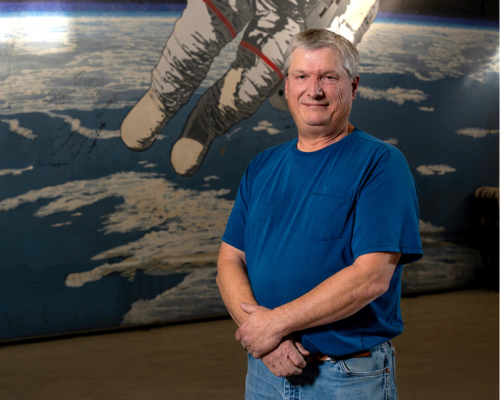 Northrop Grumman’s Steve Nielson uses craftsmanship to control the force of the Artemis solid rocket boosters. Credit: Northrop Grumman
 For 37 years, Steve Nielson has been the man in the middle, joining sections of Northrop Grumman solid rocket boosters, first for the space shuttle and now for Artemis. He’s one of the last people left on the planet with an encyclopedic understanding of the seals, which hold back millions of pounds of thrust per booster.
“There are only two of us who do it now,” he said. “We used to have 50 or 60 people.”
Nielson began working on the solid rocket boosters for the space shuttle program, learning the trade on the job. The boosters, dropped in the Atlantic Ocean on each shuttle flight, were reused. Nielson would refuel, inspect, and repair each steel segment and its mating surfaces before they were reloaded with solid rocket fuel and rejoined.
The science behind the work is well-established, the tolerances are clear, and Nielson knows every section by heart. Nielson admits his job can seem antiquated to others who don’t understand the history of the Northrop Grumman boosters.
“If you go to a Toyota assembly plant and you stick a 1967 Corolla on the line, they won’t be able to build it,” Nielson joked.
The key to Nielson’s job is precision.
“The seals’ engineering specifications have high and tight tolerances,” he said. “One anomaly and the part is scrapped.”
The fact that his boosters are bound for the first crewed Artemis flight is a big reason Nielson is a stickler for perfection.
“Humans fly on these rockets, and that’s why we take such pride in our work,” he said.
Northrop Grumman is developing a new booster for future Artemis flights, built from carbon fiber rather than steel.iii Nielson isn’t worried. The new boosters, like the old, are segmented, and segmented rockets have seals for Nielson to fix. For now, NASA is using space shuttle solid rocket boosters, with an added fifth segment for a longer burn time as the agency reaches for the Moon. For Nielson, the fifth stage gets the same care as the other four. Each must pass his tests before they go to space.
Nielson’s work is well-known to NASA. The seal on a check port of Artemis II revealed an issue as workers stacked the towering machine in in the Vehicle Assembly Building at Kennedy Space Center in Florida last year. The space agency’s answer? Call Steve Nielson. The Kennedy team flew Nielson to the space center. He had repairs finished in four hours.
Now Nielson is ready to train a new generation of experts in his field.
“I love my job and I love what I do.”
Related Articles