Featured
Artemis II Successfully Launches 4 Astronauts Toward the Moon
Written by: Jeff Gardner
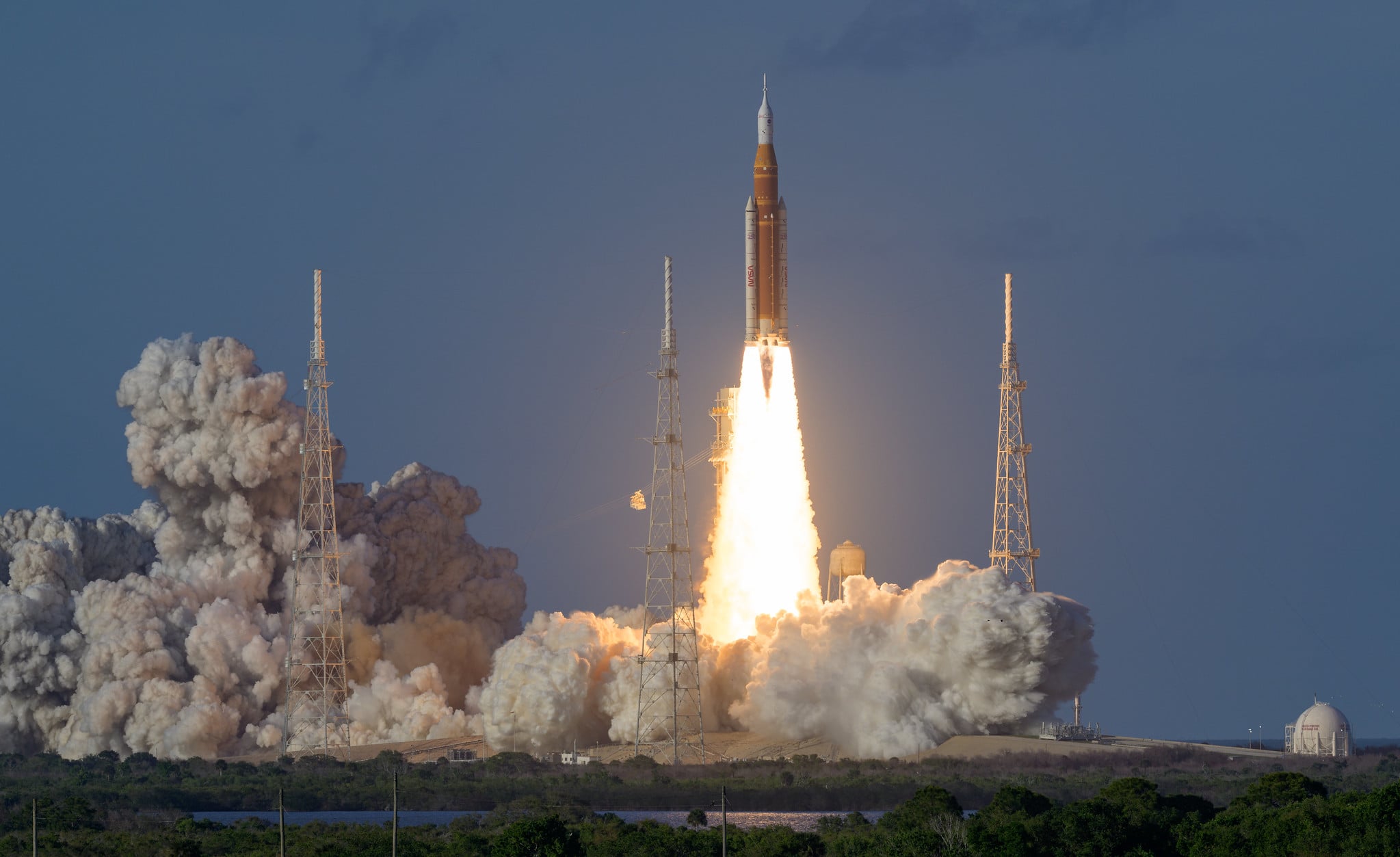 Photo Credit: (NASA/Bill Ingalls)
 For the first time in more than 50 years, humans are leaving Earth’s orbit. NASA’s Space Launch System (SLS) took off from Kennedy Space Center at 6:35:12 p.m. Eastern Daylight Saving Time on a mission that will set the stage for U.S. lunar habitation by 2028.
As the 322-foot-tall launch vehicle thundered into the sky, the small, sandy Cape was filled with cheers and upturned heads from hundreds of thousands of onlookers.
The 10-day, 600,000-mile round-trip mission will send the crew farther from the Earth than any humans have ever traveled. The crew will fly in a figure-8 around the Earth and Moon, allowing humans to look upon never-before-seen parts of the lunar far side.
NASA Administrator Jared Isaacman described Artemis II as the beginning of a national effort that will be filled with science, technology and innovation.
“Artemis II is the opening act,” he said. “It’s going to set up for the subsequent missions… that’s why we’re going into the Golden Age of science and discovery right now because you’re going to see Moon rocket launch in 2027 when we do our testing with the lander. We’re going to go for the landing on Artemis IV in 2028, and in parallel, we’re going to build the Moon base.”
Space Foundation CEO Heather Pringle, who was among the throngs to witness the event, called the launch a fulfillment of aspirations for NASA and the entire global space community.
“Today, new generations around the world share their own Moon moment,” she said. “It’s a historic point of inspiration that invites new generations to find their place with space.”
The launch comes just eight days after NASA officials announced a major program overhaul designed to align with President Donald Trump’s National Space Policy and return to the Moon before his term ends.
“If we concentrate NASA’s extraordinary resources on the objectives of the National Space Policy, clear away needless obstacles that impede progress, and unleash the workforce and industrial might of our nation and partners, then returning to the Moon and building a base will seem pale in comparison to what we will be capable of accomplishing in the years ahead,” Isaacman said in the March announcement.
A Cape of Hope
Excitement at Kennedy Space Center on Cape Canaveral was palpable for the Artemis II launch. People traveled from around the world to witness 6 million pounds of technology rumble and rise.
Although roughly 75% of the world was not alive the last time humans were on the Moon, several of those who witnessed the Apollo missions made it out for the launch. Murmurs of “I can’t believe we’re going back” and “This is actually happening!” spread through the NASA campus as the rocket filled with fuel and the crew drove out to the launchpad.
Crowds lined the road to the launchpad, waving flags to honor the three Americans and one Canadian on the crew. The roar of the military convoy — police, helicopters, astronauts — threatened to drown out the cheers, but the excitement was never lost.
A Crew Like No Other
The Artemis II crew is historic for multiple reasons. It includes the first woman, first person of color, and first Canadian citizen to leave Earth’s orbit.
Reid Wiseman serves as mission commander. A NASA astronaut since 2009, Wiseman has spent 165 days in space and conducted two spacewalks. Wiseman also served as chief of the Astronaut Office from 2020 to 2022. As commander, he is responsible for the safety and overall success of the crew.
Victor Glover operates the Orion spacecraft as the mission’s pilot. The crew member most recently in space, he also piloted the first commercially crewed flight to the International Space Station (ISS) in 2020. On his spaceflight, Glover spent 168 days in orbit and conducted four spacewalks.
Christina Koch has spent more time in space than any other Artemis II crewmember. Her spaceflight to the ISS lasted for 328 days — the longest any woman has spent in space at once. As a mission specialist, she will be responsible for testing and validating Orion’s hatch operations and life support systems.
Jeremy Hansen is travelling to space for the first time. An astronaut from the Canadian Space Agency, he will be the first citizen of his nation to leave Earth’s orbit. As a mission specialist, Hansen is responsible for the proper functioning of multiple Orion instruments, including navigation systems.
“The thing that really draws me and excites me about the future is the opportunity to be a part of kindling America’s passion for aerospace and space,” Glover said.
A Vision for the Moon
The Artemis program, established in 2017, aims to return humans to the Moon, establish an enduring lunar presence, foster the cislunar economy, and set the stage for a voyage to Mars. The last astronaut journey to the Moon, the U.S. Apollo 17 mission, was in December 1972.
Each mission in the Artemis program builds off the last. Artemis I, launched in 2022, flew around the Moon without a crew to test Orion and SLS. This mission sends humans on a lunar trajectory but will not land on the lunar surface. Instead, the Orion spacecraft will travel on an elliptical orbit around the Earth and Moon, testing various scientific instruments and deploying CubeSat payloads. During the 10-day mission, wearable sensors will monitor the impacts of deep space travel on the human body. Additionally, upon return scientists will analyze blood and saliva samples from the crew to track immune system changes.
Artemis III, scheduled for 2027, will test commercial lunar landers from SpaceX and/or Blue Origin. Artemis III was originally planned to be a crewed lunar landing, but in February 2026, NASA announced an overhaul to the program for additional systems testing.
NASA is aiming for Artemis IV in 2028 to return astronauts to the lunar surface.
Related Articles