Symposium Sessions
Building a Map to the Moon
Written by: Jeff Gardner
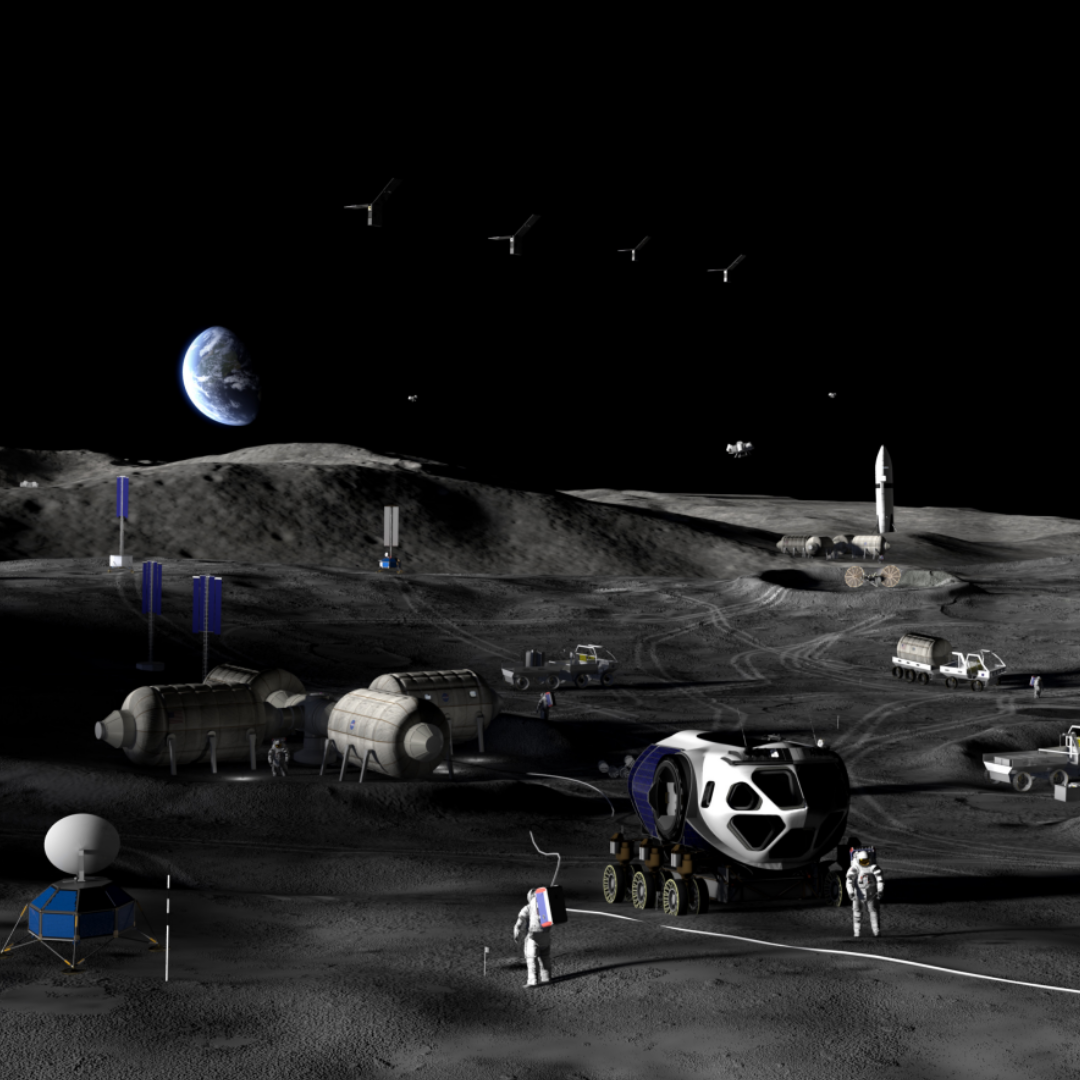 NASA’s plan for a lunar base consists of three phases. Phase One: Build, Test and Learn. Phase Two: Establish Early Infrastructure. Phase Three: Enable Long-Duration Human Presence. Credit: NASA
Over the next decade, dozens of robotic landings and a handful of crewed landings are anticipated to build an enduring presence on the lunar surface. Beyond the race for international prestige upon a successful landing, there are multiple benefits for returning to the Moon: national security, potential resource utilization, a gateway for missions deeper into space, and astronomical insights.
NASA has committed to an increased cadence for lunar landings, establishing a lunar base by 2030, and laid out plans to ensure a U.S. presence in low Earth orbit (LEO) as NASA also weighs replacing the International Space Station (ISS). This accelerated timeline, unveiled at its Ignition event in March, is driven by a race with China and by national security implications in LEO and on the Moon. These new ambitions involve NASA increasingly relying on commercial partners.1
“The clock is running in this great power competition, and success or failure will be measured in months, not years,” NASA Administrator Jared Isaacman said at the Ignition event.2 “If we concentrate NASA’s extraordinary resources on the objectives of the National Space Policy, clear away needless obstacles that impede progress, and unleash the workforce and industrial might of our nation and partners, then returning to the Moon and building a base will seem pale in comparison to what we will be capable of accomplishing in the years ahead.”
This new roadmap still supports the flagship Artemis missions with NASA astronauts but calls for dozens of robotic, commercial missions to help build the groundwork for a lunar base. The agency will target crewed landings every six months beginning in 2028. With this revision, NASA is partnering with legacy and newer contractors for reusable hardware to undertake frequent and affordable missions to the lunar surface.
“Ignition was no less than Jared Isaacman opening up the Moon to the entire world,” said Mike Gold, president of Civil and International Space at Redwire.3
Gathering Momentum
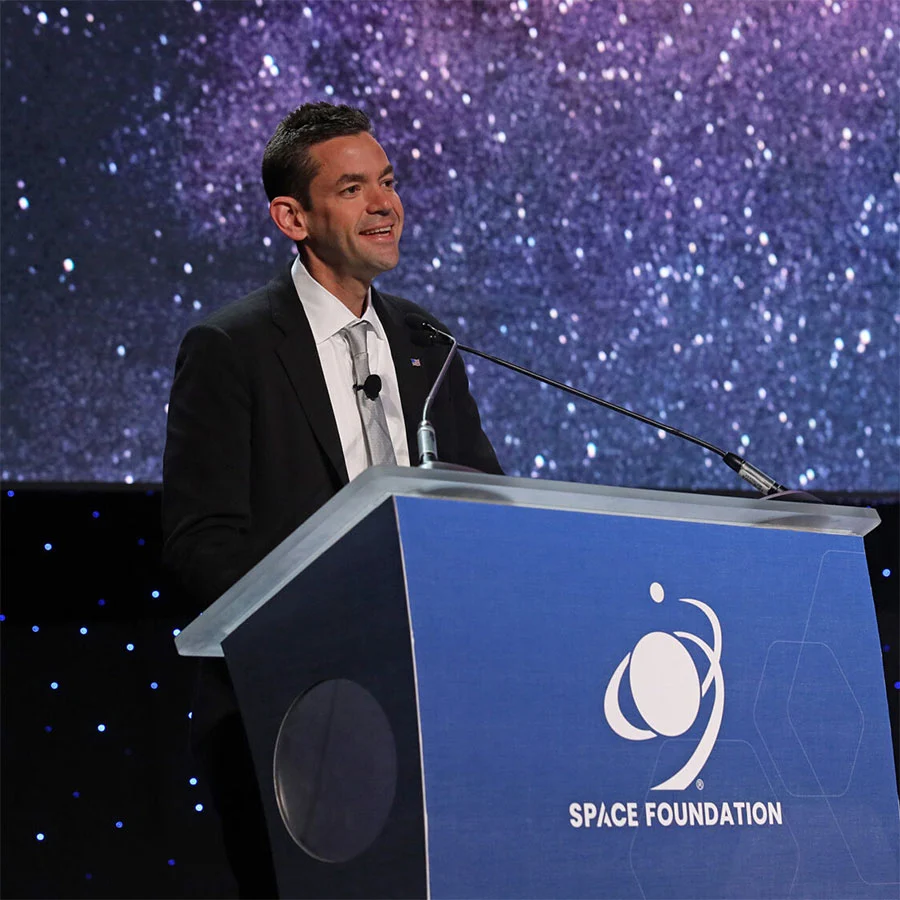
At the 41st Space Symposium, NASA Administrator Jared Isaacman emphasized the importance of commercial partners in establishing a permanent lunar presence. Credit: Space Foundation
This announcement echoed through conversations and presentations at Space Foundation’s 41st Space Symposium, where more than 13,000 space professionals gathered in April to help shape the future of the industry. Speakers from NASA officials to industry leaders discussed the opportunities of an increased launch cadence and the promises of a lunar base.
Isaacman emphasized that point from the main stage at Space Symposium, acknowledging the close relationship between government and industry in space infrastructure.
“We can’t force a lunar economy or an orbital economy to exist, but we can do everything possible to incentivize one,” he said.
NASA maintains a robust pool of private partners through its Commercial Lunar Payload Services (CLPS) program. The agency has awarded contracts to more than a dozen companies, including Intuitive Machines, Astrobotic, and Firefly Aerospace.
NASA Lunar Phase One Requests for Information
• Reliable modules for surface habitation.
• Fission surface power system. 12
• A secondary communication system for the Orion spacecraft on the Artemis III mission. 13
• High-definition cameras orbital maneuvers and surface exploration.
• Mapping and reconnaissance capabilities for lunar resources.
• Increased launch cadence to the Moon. 14
The CLPS program has a maximum contract value of $2.6 billion through 2028, with an average task order price of roughly $150 million.4
Carlos Garcia-Galan, NASA’s program executive for the Moon Base, explained in a Symposium session that the base will be constructed in three phases. In phase one, NASA and commercial partners will establish reliable access to the lunar surface and begin experiments. Phase two, starting in 2029, will see permanent pieces of infrastructure delivered and initial Moon Base operating capability. Phase three, beginning in 2032, will come when crews are performing long-duration missions on the lunar surface and achieving a semi-permanent presence on the lunar surface.
Phase one, planned through 2028, includes 22 missions to the Moon: 10 in 2027 and 12 in 2028. During this phase, the agency will focus on improving supply chains, increasing manufacturing capability and capacity, and focus on establishing reliable access to test facilities in space.
Garcia-Galan explained from the Symposium stage that NASA has released multiple Requests for Information for companies to contribute to lunar missions. NASA needs new commercial partners to build communications and PNT networks, to provide power and to build spacecraft and landers.5
Charles Powell, assistant director for Space and Spectrum at the White House Office of Science & Technology Policy, in the same discussion listed three key reasons for a lunar base: science benefits, such as improved astronomical viewing and studying the effects of space on human health; programmatic benefits, as there is increased potential in two domains (orbit and surface); and commercial benefits, where industry can provide instruments or infrastructure.
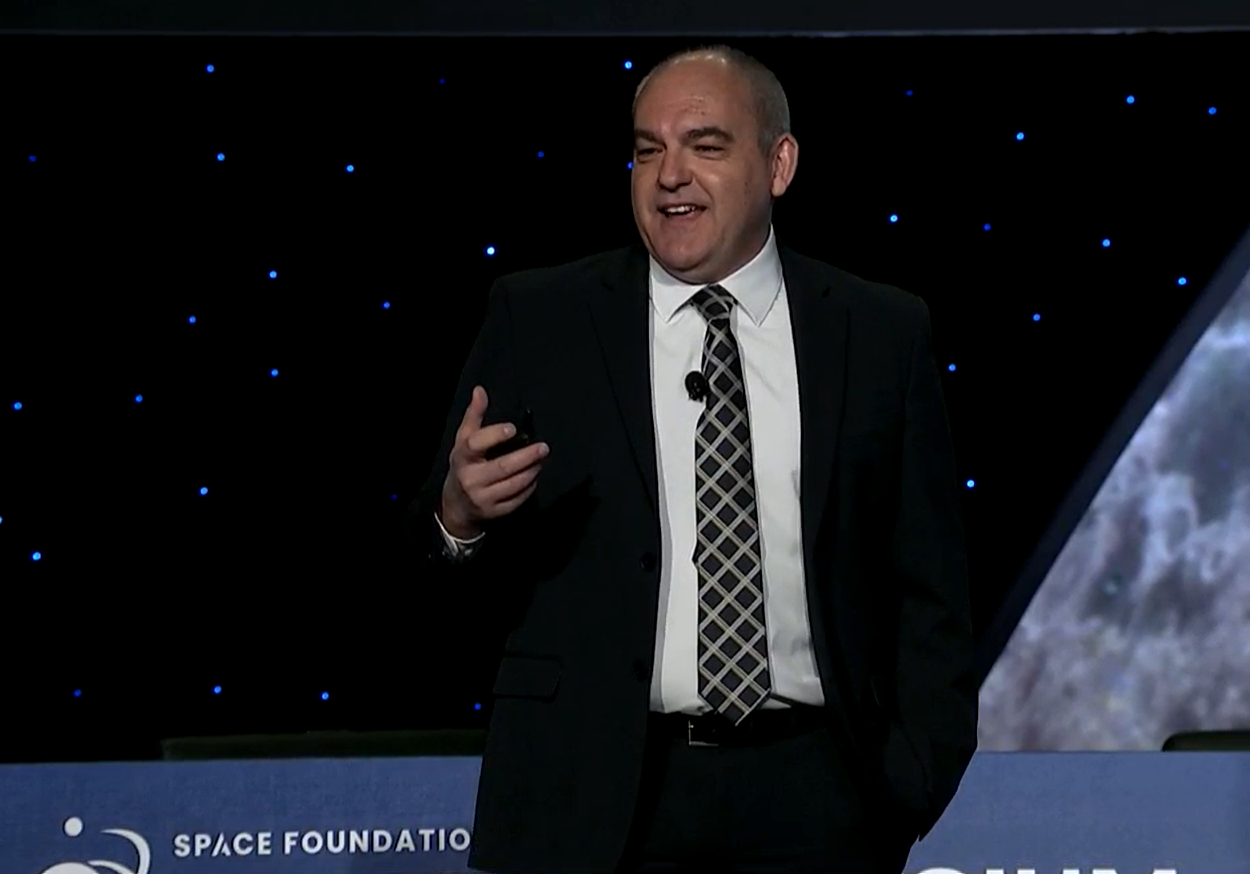
Carlos Garcia-Galan, NASA’s program executive for the Moon Base, discusses the increased cadence of missions to the Moon at the 41st Space Symposium. Credit: Space Foundation
“We don’t yet have a lunar economy, but nobody here should doubt that one will take root as soon as we start building the base in earnest,” Powell said. “There’s a great deal of economic activities that can generate organic commercial business cases.”
In April, NASA’s Johnson Space Center announced its intent to increase financial commitment to the lunar surface by CLPS program contracts’ maximum ordering value from $2.6 billion to $4.2 billion. The agency stated the increase would be to integrate and operate launch vehicles, lunar lander spacecraft, lunar surface systems, Earth re-entry vehicles and associated resources.6
Since Ignition, NASA has awarded contracts to a variety of entities with the purpose of exploring the Moon: universities, space companies, and machines shops are all involved. NASA in May awarded $6.9 million to Interlune to develop a machine to extract helium-3 and hydrogen from lunar regolith. This is planned for 2028. The agency also contracted Intuitive Machines for $180 million to deliver seven payloads, five of which are NASA’s, to the lunar surface. These will increase understanding of the chemical composition and structure of regolith. The delivery is planned for the Moon’s South Pole region in 2030.
Max Haot, CEO of Vast, drew parallels between commercial launches to the ISS and commercial launches to settle the Moon. Industry has the potential to rapidly increase the cadence and capability of NASA commercial missions.
“The success story already exists. The business model already exists,” Haot said. “And this is the next step.”
What Moon is Rising?
One question permeated panels at Space Symposium and remains top of mind for those watching the increased activity surrounding the Moon’s surface: Can the cislunar economy be economically viable and sustainable without government support? The answer is slowly becoming a “yes,” but much remains to be built, both in terms of infrastructure and a customer base.
Moon base supporting vehicles
• Lunar Terrain Vehicles (LTV): Can operate crewed or uncrewed. Max speed 10km/hr. 500 kg maximum rover mass.
• Volatiles Investigating Polar Exploration Rover (VIPER): Will explore for water ice and other resources. 100+ day mission. Traversing 30+ km. 450 kg rover mass.
• MoonFall drones: Fleet of four autonomous, hopping drones mounted with camera and scientific instruments. Each drone will be capable of several propulsive hops covering up to 50km each.
• Pressurized rover: Mobile habitat to extend human exploration range. Max speed 3.5 km/hr. 15,000 kg rover mass.
“Commercial is no longer a supplement to government services. In many ways, it is leading innovation,” said former National Space Council Executive Secretary Chirag Parikh at Symposium.7
The commercial space sector accounts for 78% of the global space economy according to Space Foundation research. With renewed government support behind cislunar programs and vigorous investment activity, commercial sectors are poised for significant growth, including satellite communications and launch services.8
Outside the competition between the United States and China, several other countries have missions planned to the Moon in the coming years. Following its historic 2023 lunar landing, ISRO is developing Chandrayaan-4, a complex robotic sample-return mission slated for 2028, with the ultimate goal of landing an Indian crew by 2040.
Concurrently, JAXA is following up its 2024 landing with an ISRO Indian Space Research Organization (ISRO) partnership, the Lunar Polar Exploration Mission (LUPEX), to hunt for water ice. South Korea is also moving forward. After successfully orbiting the Moon with the satellite Danuri in 2022, Seoul authorized its first robotic lander for a 2032 touchdown.
Overhead Costs
The world is betting on an enduring lunar presence. In 2024, Intuitive Machines was poised to become the first private company to land on the Moon. The company’s stocks increased more than 300% in the leadup to the IM-1 landing. However, stocks decreased (still above their initial level) when news broke that the lander tipped on its side. It was a similar story with IM-2; stocks spiked to their highest point thus far ahead of the company’s second mission, and again plummeted upon news of a tilted lander.9 As of May 2026, Intuitive Machines’ stock is at its highest point, more than $35 per share.
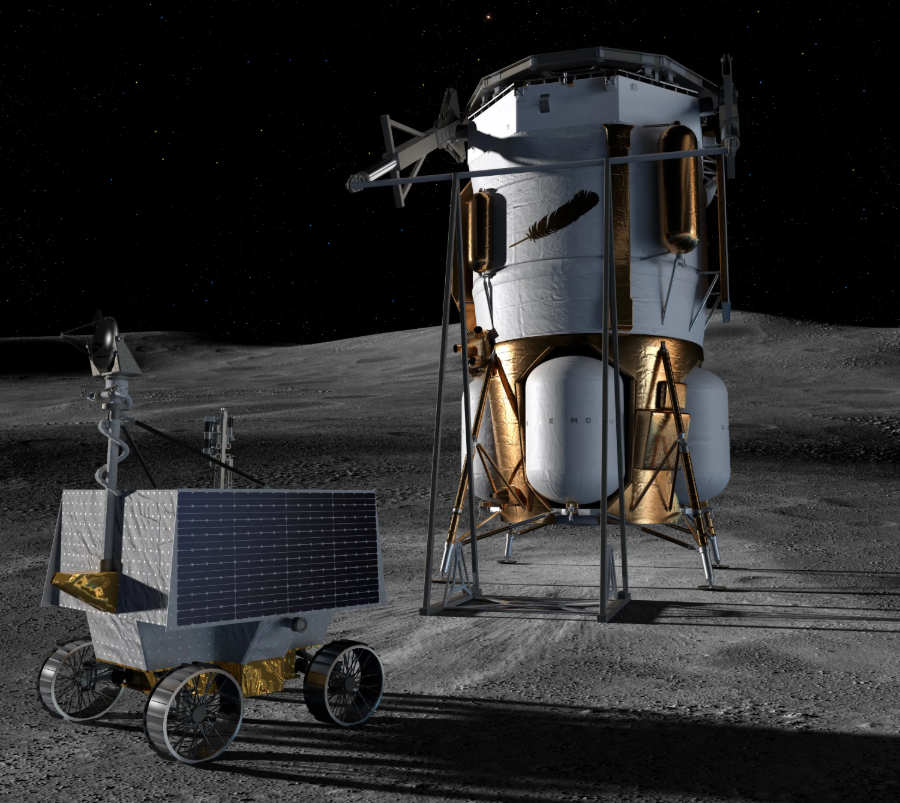
NASA selected Blue Origin to deliver the VIPER rover to the Moon’s south pole in late 2027. Credit: NASA
Just as onlookers were thrilled about returning to the Moon during the Artemis II launch, so were investors. In the two weeks following the Artemis II launch, Rocket Lab and Firefly Aerospace stocks increased nearly 30%.10 As of May 2026, Rocket Lab stock has continued to increase while Firefly has decreased slightly.
Signaling the extent of commercial growth, SpaceX plans for an initial public offering (IPO) in June 2026. With an expected valuation of more than $1.5 trillion, the SpaceX IPO may be the biggest in history. This IPO does include other Musk ventures, such as his AI firm, but SpaceX makes up the majority of the value. Some speakers at Symposium identified the IPO as the next great moment for the space industry.11
At a Symposium discussion about lunar infrastructure, OffWorld CEO Jim Keravala argued that the lunar surface is at an inflection point, describing the Moon as a continent-sized expansion to the Earth’s economy.
“The surface of the Moon has become inexorably intertwined with the economy of the Earth,” Keravala said. “The economy has changed. The world has changed.”

Jeff Gardner is a senior writer at Space Foundation. He can be reached at [email protected].
1 NASA. “Ignition.” www.nasa.gov/ignition.
2 Lauren E. Low. NASA. “NASA Unveils Initiatives to Achieve America’s National Space Policy.” March 24, 2026. www.nasa.gov/news-release/nasa-unveils-initiatives-to-achieve-americas-national-space-policy.
3 Spoken at 41st Space Symposium during “Building Beyond Earth: Outfitting the Next Generation of Commercial Space Stations” session. April 15, 2026.
4 Mike Turner. The Journal of Space Commerce. “CLPS at 30 The Revenue Math Behind NASA’s Lunar Landing Acceleration.” April 7, 2026. www.exterrajsc.com/p/clps-at-30-the-revenue-math-behind.
5 Jeff Gardner. Space Foundation. “The Next Great Economy: The Moon.” www.spacefoundation.org/2026/04/16/the-next-great-economy-the-moon.
6 SAM.gov. “Commercial Lunar Payload Services (CLPS) 1.0.” April 27, 2026. https://sam.gov/workspace/contract/opp/1f27cfaee7f14c6d9a0a730599ef8fd8/view.
7 Spoken at 41st Space Symposium during ” Fireside Chat: US-International Commercial Partnerships.” session. April 15, 2026.
8 Space Foundation. “The Space Report 2025 Q2 Highlights Record $613 Billion Global Space Economy for 2024, Driven by Strong Commercial Sector Growth.” www.spacefoundation.org/2025/07/22/the-space-report-2025-q2/
9 Michael Sheetz. CNBC. “Intuitive Machines stock has more than tripled. How Wall Street reads the moon-fueled rally.” Feb. 22, 2024. www.cnbc.com/2024/02/22/intuitive-machines-stock-surge.html.
10 Tyler Bundy. TheStreet. “Space stock flies following successful Artemis II launch.” April 3, 2026. www.thestreet.com/investing/stocks/space-stock-flies-following-successful-artemis-ii-launch.
11 Adam Spatacco. Yahoo Finance. “Should You Buy the $1.75 Trillion SpaceX IPO? Here Is What History Says.” April 28, 2026. https://finance.yahoo.com/markets/stocks/articles/buy-1-75-trillion-spacex-145000877.html.
12 https://sam.gov/workspace/contract/opp/6af0e42071cb412e809511f18627cc46/view
13 https://sam.gov/workspace/contract/opp/f8013b7e0816497e8ee797f2c4cdf8ef/view
14 https://sam.gov/workspace/contract/opp/75a571f0a6ac4739b25e618c1f0e4d9f/view
Related Articles