
Featured
Martian Sample-Return Mission Launches
Written by: Jeff Gardner
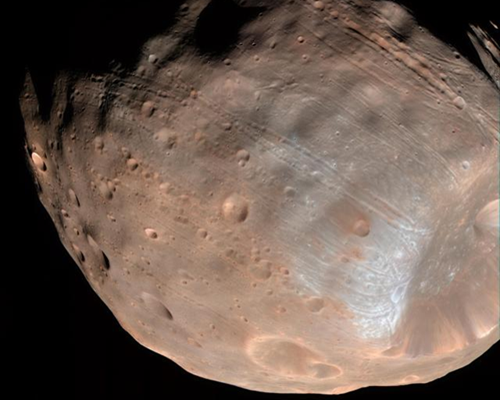
NASA is playing a key role in a JAXA mission that could return a sample from the Mars system for the first time in history. The Martian Moons eXploration (MMX) mission launched October 20 from Japan. It is scheduled to arrive near the Martian moons Phobos and Deimos in August 2027. The spacecraft will collect a sample from Phobos in December 2028 and deliver it to Earth in 2031.
NASA is providing multiple scientific instruments for the mission. This includes the spacecraft’s spectrograph, which will help scientists understand the composition of the Martian moons. So far, NASA’s Perseverance is the only mission to have gathered a Martian sample. Attempts to observe and land on Mars began in 1960, but the first successful landing, by the United States, didn’t happen until 1976 with the Viking 1 lander. In total, 12 out of 19 attempted robotic landings on Mars have been successful.
“By uncovering the moon’s origin, we’ll gain new insights to the history of both Mars and Earth, especially those events that shaped both planets billions of years ago and helped create the worlds we see today,” said Thomas Statler, lead scientist for Solar System Small Bodies in NASA’s Planetary Science Division, at an Oct. 15 press conference.
Mission Could Solve a Martian Mystery
The Martian moons’ unusual shapes raise questions about their origins. There are competing theories on the moons’ origin. Either they are asteroids that Mars caught in its orbit or former pieces of Mars ejected during an ancient collision.
The mission should capture at least 10 grams of material from Phobos. NASA will receive roughly 15% of the MMX sample. NASA’s full cost for involvement across the entire mission is estimated at $87 million.
“By going to the Martian moons, studying them up close, and bringing samples back to Earth, we’ll be able to determine whether Phobos material is more consistent with an asteroid composition or with debris created by a collision involving Mars,” Statler said.
Related Articles