Symposium Sessions
Trump Administration Pushes Nuclear for Spacecraft, Moon
Written by: Tom Roeder
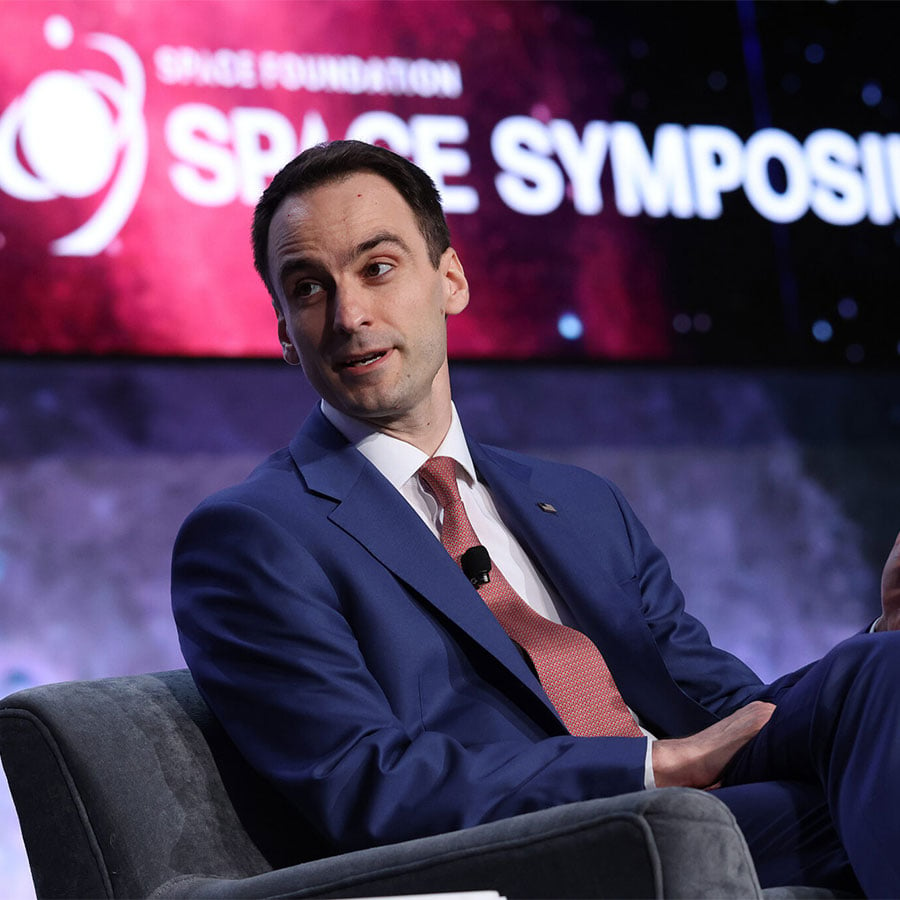
At the 41st Space Symposium on Tuesday, the White House announced a new push for nuclear power in space that includes requiring NASA and the Department of War to initiate design plans for reactors in cislunar orbit and on the lunar surface.
Michael Kratsios, director of the White House Office of Science and Technology Policy (OSTP), released a memo creating the National Initiative for American Space Nuclear Power, a NASA-led effort to coordinate reactor plans from all federal agencies. President Donald Trump has personally endorsed the plan, Kratsios said.
“I do think we are firing on all cylinders when it comes to space,” he said.
Agencies are directed to establish cost-effective private partnerships to safely deploy nuclear reactors in orbit by 2028 and on the Moon by 2030.
Reactors for in-space propulsion and to power a lunar base have been envisioned since the 1950s, but technical and financial hurdles have scuttled programs. The reactor project is seen as key to a base at the Moon’s south pole, where electricity could convert ice deposits to water and rocket fuel. Nuclear engines also are seen as key to sustaining NASA’s Mars plans.
NRO Launches 200 Satellites in 2 Years
The National Reconnaissance Office has launched 200 satellites in the past two years, allowing the agency to make 400,000 “collections” in 2025, a term for Earth observation and other intelligence finds.
NRO Principal Deputy Director Bill Adkins, who runs day-to-day operations of the agency, disclosed the number Tuesday at the 41st Space Symposium.
The public mention of any numbers has been exceptionally rare for NRO, an agency formed in 1960 but only publicly acknowledged by the government in 1992.
Adkins noted that in 2025 alone, the NRO’s proliferated architecture captured more than 400,000 collections – an incredibly large data set that is helping the organization answer questions and optimize the use of machine learning algorithms.
Advanced technologies, including artificial intelligence and machine learning, enable satellites to conduct adaptive tasking, autonomous operation, enhanced coordination within the constellation, and more efficient utilization. The constellation is shortening revisit times, increasing observational persistence, and improving resilience and security. Combatant Commands and other users are being trained on the constellation’s tasking and the analytic tools that strengthen its performance.
“Simply put, we are making it harder for adversaries to hide,” he said. “And harder for them to disrupt our capabilities.”
The agency in recent years has committed to a proliferated architecture, with several constellations of satellites in several orbits along with data purchased from commercial satellites. The agency has grown its industrial base to encompass 250 prime contractors and 5,000 subcontractors.
Get Space Symposium Updates Delivered to your Inbox!
Related Articles