
Featured
Low Earth Orbit Strengthens Role as a Research Destination
Written by: Space Foundation Insights Team
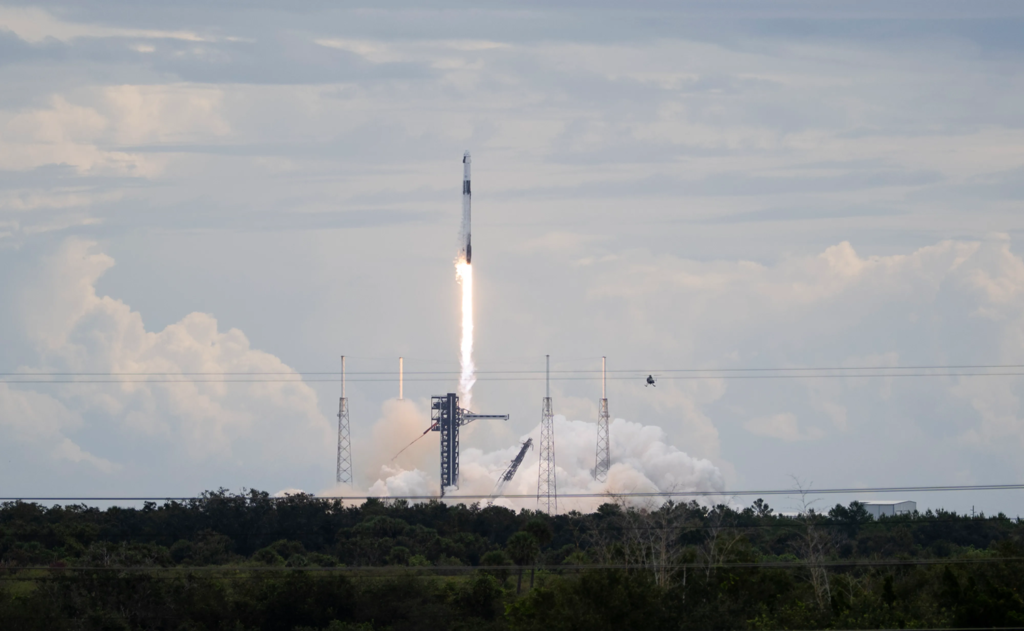
Crew-13 launches into orbit aboard a SpaceX Falcon 9 from Cape Canaveral. Credit: NASA
The cutting-edge of science is in orbit above the Earth. The fields of biotechnology, materials science, propulsion and energy systems are advancing as the United States, China, Europe, and private industry increasingly bet on low Earth orbit (LEO) as the next great laboratory.
Four astronauts launched on board a SpaceX Falcon 9 to the International Space Station (ISS) on October 1 for its Crew-13 mission. The crew will spend six months on the space station conducting experiments to support future long-duration missions. These include research on diagnostic medical equipment and crop growth in space.
Crew-13 includes two NASA astronauts, mission commander Jessica Watkins and pilot Luke Delaney. The mission also includes two international astronauts: Canadian Space Agency astronaut and mission specialist Joshua Kutryk, and Roscosmos cosmonaut and mission specialist Sergey Teteryatnikov.
“Research, every experiment on board, is a contribution to the future,” Teteryatnikov said. “Every single piece of research as an area can discover something new for us.”
While onboard the ISS, Crew-13 will use microgravity to produce human stem cell‑derived tissues. This can improve disease modeling and testing for conditions like Parkinson’s.
“Our steady cadence of commercial crew launches demonstrates the essential role the International Space Station plays in sustaining our presence in Earth’s orbit and sharpening the tools we’ll take forward to the Moon and Mars,” said Dr. Lori Glaze, associate administrator of NASA’s Human Spaceflight Mission Directorate.
A Growing Route to Research
The draw of LEO benefits civil and private space and is increasingly bringing them closer. A record-breaking 115 ISS National Lab-sponsored payloads were delivered to the station in FY25. Nearly 80% were commercial research projects. In the same year, the ISS brought in more than $10 million in external, non-NASA funding, with 65% coming from commercial entities.
Space agencies around the world are preparing for the planned deorbiting of the ISS in 2031. The European Space Agency recently awarded a contract to two industrial coalitions to study the feasibility of a European orbital research station. The study will be conducted by two European industrial groups led by Airbus Defence and Space and OHB. The two industrial studies will run for approximately nine months.
“Europe has built world-class capabilities in human spaceflight through decades of international cooperation. We are now facing the opportunity to shape our collective future while safeguarding the excellency of our engineers and industry,” said Daniel Neuenschwander, ESA’s Director of Human and Robotic Exploration in a press release.
Upward Mobility
It’s not just governments that are seeing massive opportunities in orbital research. Concurrent with the ESA study, in-space manufacturing startup Varda Space announced a $250 million funding round. This raises the company’s valuation to $1.6 billion.
Varda is developing uncrewed platforms that can serve as on-orbit labs for pharmaceuticals, advanced manufacturing, and materials science. Varda has launched six test missions to orbit, with a new generation of spacecraft planned for release in 2030.
Thursday’s launch also came on NASA’s 68th anniversary.
Related Articles