Symposium Sessions
U.S. Space Command Plans for Maneuver Warfare in Orbit
Written by: Tom Roeder
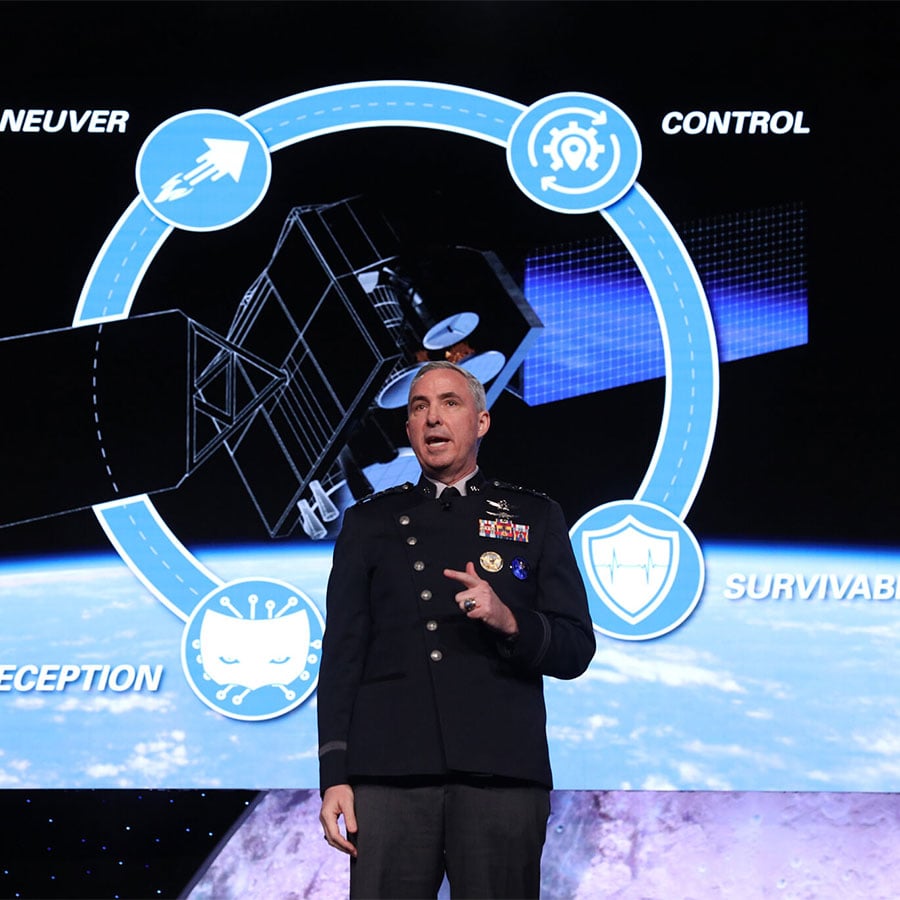
April 14, Colorado Springs — U.S. Space Command’s Gen. Stephen Whiting told a Tuesday morning audience at the 41st Space Symposium that he needs satellites that can reposition when necessary to maintain dominance in space.
The focus on maneuver warfare is new and would require innovations, to include on-orbit servicing, to accomplish. The general didn’t offer specifics but cited China’s flights of two satellites in 2025 that demonstrated on-orbit servicing and coordinated maneuvers. Those flights changed how his command would fight, with a focus on satellites that can evade or pursue enemies.
“The way we fight must evolve with the realities of the world we now live in,” Whiting said.
New weapons shape deterrence
U.S. military satellites since the 1960s have gone to space with limited fuel reserves, leaving most satellites in fixed, predictable orbits, which Whiting said would make them targets in a space war. China’s new capabilities, while presented as civil space and scientific successes, could also represent a new generation of anti-satellite technology.
“Capability, not intent, shapes deterrence,” Whiting said.
Whiting’s efforts for maneuverability in space are reflected in the Space Force’s 2027 budget proposal, which includes $40 billion for research and development. To obtain the technology to enable maneuver warfare, Whiting said he plans to lean heavily on industry, where start-ups and traditional defense contractors are developing space technology at a record pace.
But first, Space Command is developing tactics that could be used in combat. The command launched a series of war games called the Apollo Maneuvers this year. The simulation allowed military leaders to foresee what kinds of systems they would fight in space.
Whiting said China is also developing systems to project power beyond Earth orbit, with a planned lunar base. Because of that, the general said, NASA’s lunar programs to plant an American flag on the Moon have grown in importance.
“Artemis is securing the next generation of key terrain,” Whiting said.
Get Space Symposium Updates Delivered to your Inbox!
Related Articles