Symposium Sessions
Panel: New Rules, New Defenses Could Bring Order to Booming Growth in Orbit
Written by: Tom Roeder
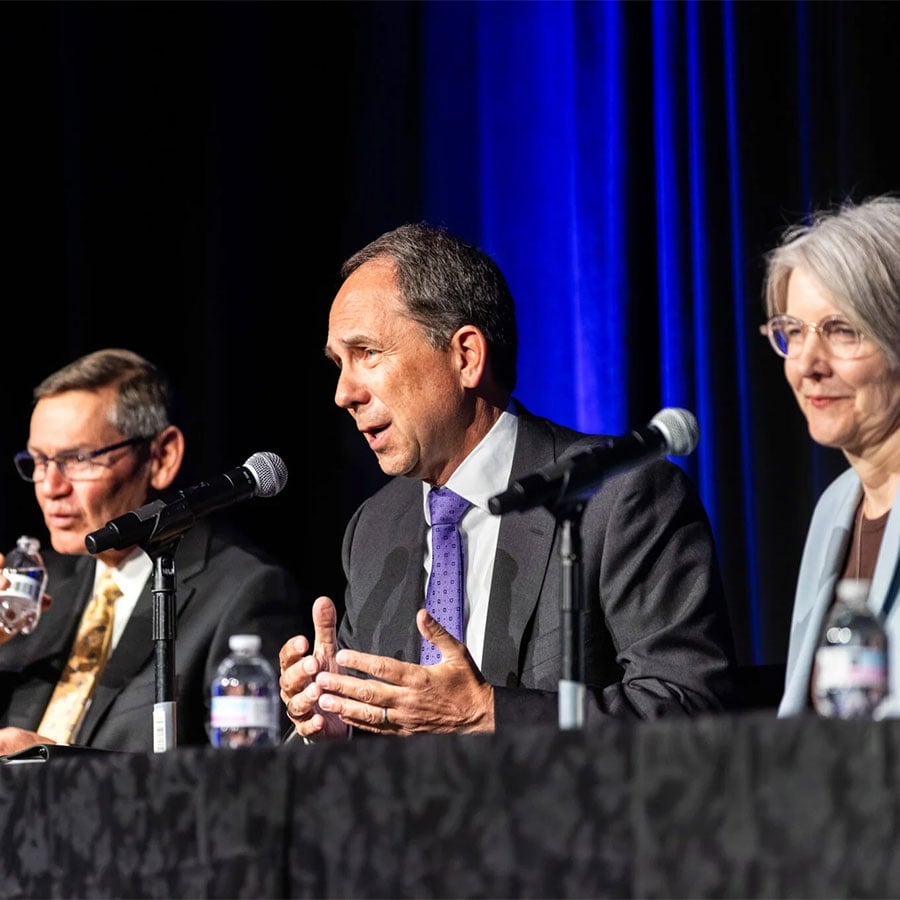 Highlights from the 41st Space Symposium’s “Assured Access to Space: Red Lines in a Dangerous Moment” at the Broadmoor’s International Center in Colorado Springs, Colo. on Thursday, Apr. 16, 2026. (Liz Copan/The Space Foundation)
 Maintaining access to space in a more crowded and contested environment will require new infrastructure, manufacture of new launch vehicles, and a clear set of “red line” rules to keep rogue actors in line, a panel of experts told a 41st Space Symposium audience Thursday.
In conflicts over the last two years, commercial and space assets were subjected to jamming and cyberattacks that affected civilian life on the ground and sent shockwaves through the burgeoning space industry.
“Unlocking new technologies and new frontiers can lead to bad behavior,” said Mike Dickey, a founding partner of space consultant firm Elara Nova. “Consequences can cascade from the physical environment of space to the terrestrial world where billions of people rely on space systems in their daily lives.”
Lunar Ambitions Bring New Concerns
The problems grow even more complex as nations including the United States, Russia and China look to form permanent bases on the Moon. Panelists said some form of policing could be needed as more nations look to plant flags on the Moon.
“I think you will hear more about the lunar environment from the Space Force and U.S. Space Command,” said retired Space Force Lt. Gen, John Shaw. “When it starts to get crowded and there are some (players) that could be up to mischief, I think that isn’t not a NASA problem, and the Space Force should become involved.”
Threats to Space Access Start on Production Line
John Elbon, the interim CEO of United Launch Alliance, said threats to space systems start long before launch. Vulnerabilities include potential insider threats in the manufacture of launch vehicles and terrorist threats when launch vehicles head to the pad ahead of launch.
Launch facilities in the United States are overburdened, Elbon said, with an expected record 206 launches in 2026 from three spaceports: Cape Canaveral in Florida, Vandenberg Space Force base in California and the spaceport at Wallops Island, Virginia.
“We are getting to a point where the launch infrastructure is stretched,” he said.
EU Edges Toward Regulatory Plan
The European Union wants to solve some of the issues arising in orbit with a rulebook, said Marjolijn van Deelen, the European Union’s Special Envoy for Space.
“We do have some have some rules especially the U.N. Outer Space Treaty, but it has become clear that is not enough,” she said, noting that the Ukraine war began with a Russian hacker strike on European communication satellites.
The EU is debating a set of regulations that satellite companies doing business with EU member states would be forced to follow.
“We are advocating for a set of global rules that everyone has a clear understanding,” she said.
Attacks in Space Could Bring Earthly Response
Laws are great but need police officers to enforce them, Shaw noted. U.S. Space Command has announced it can respond to space threats with every military tool, including bombs and ground troops.
“The question is when those red lines get tested, how do you respond?” Shaw asked noting that credible deterrence must be a major component to back up any new space rules.
Treating attacks in space like any other enemy strike gives commanders and advantage, Shaw said.
“We have increasing tools in space that respond,” Shaw said, “but they aren’t our only tools.”
Get Space Symposium Updates Delivered to your Inbox!
Related Articles