
Transcripts
What You Missed On The Vector Episode 27: Space Investment Analysis: Implications of the New Global Space Economy
Written by: Morsiell Dormu
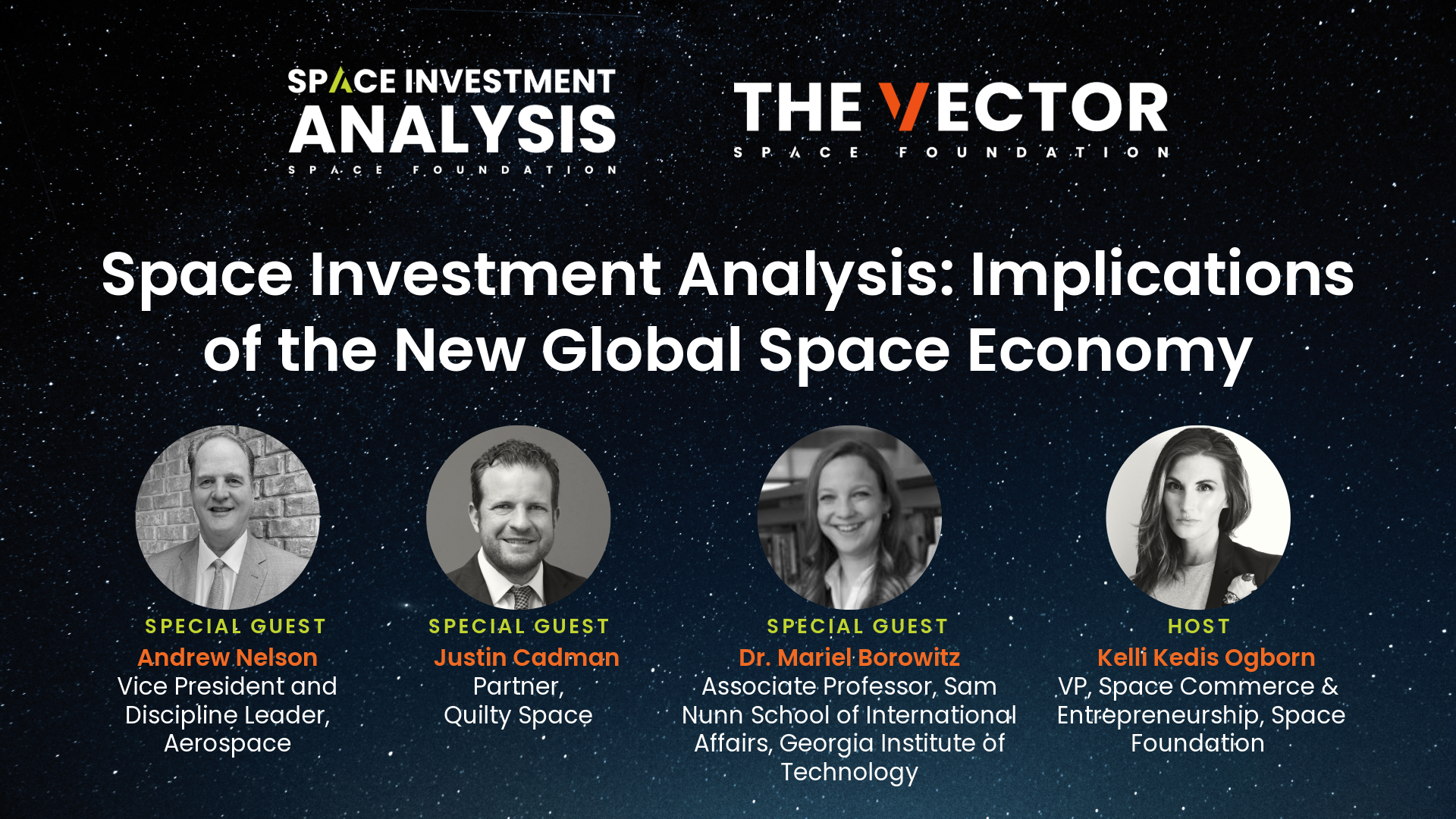
This quarterly episode of The Vector dives into the newest edition of The Space Report to examine key market figures, growth trends, and investment insights that shape the trajectory of the space economy. The panel discusses the implications of a $613 billion space economy, increasing commercialization, and geopolitical positioning.
Key Themes and Insights
Space Economy Growth
-
The global space economy reached $613 billion, a 7.8% increase from the previous total.
-
Commercial activity accounts for 78% of this total, suggesting strong market maturity.
-
The five-year compound annual growth rate is projected at 7.6%.

Sector Trends and Acceleration
-
High-growth areas include:
-
Commercial human spaceflight (+611%)
-
ISAM (In-Space Servicing, Assembly, and Manufacturing) (+168%)
-
Space situational awareness (+200% over 3 years)
-
-
However, many of these gains are from a small activity base and should be interpreted within that context.
Risk, Insurance, and Regulation
-
Despite the risks, only 1% of LEO satellites are insured.
-
Redundancy in constellations and declining satellite costs reduce perceived insurance needs.
-
Regulatory changes around orbital debris and deorbiting may alter the insurance landscape in the near future.
Lunar Commercialization and Government Partnerships
-
NASA is using a COTS-like model to support commercial lunar missions (e.g., CLPS).
-
Companies are blending NASA support with private and foreign customers.
-
The shift to commercial-led systems may reflect a long-term structural change in space exploration.
Strategic Competition: U.S. vs China
-
China continues a state-driven model, while the U.S. focuses on a commercial-first approach.
-
U.S. companies benefit from open markets and diverse partnerships, but must maintain policy consistency to stay competitive.
-
The rise of international payloads on Chinese missions suggests soft-power competition is escalating.
Defense Spending and Dual-Use Technology
-
U.S. government space spending totaled $77.3 billion, with 64% going to defense and intelligence.
-
Commercial firms are integral to defense strategies, especially in remote sensing and communications.
-
International customers increasingly seek U.S. capabilities, driving global market demand.
European Strategic Autonomy
-
The European Space Agency is investing in independence, particularly in satellite manufacturing, SSA, and LEO constellations.
-
This could limit U.S. market share but foster healthy global competition.
-
Success will depend on sustained political and financial commitment from European governments.
Investment Trends and Market Maturity
-
2024 saw 232 funding rounds over $200,000, with more private equity and corporate investors entering the market.
-
Consolidation is increasing, with examples like York’s acquisition of Atlas and Redwire’s roll-up of hardware providers.
-
The return of space IPOs suggests growing public investor confidence.
Looking Ahead to 2025
-
Andrew Nelson expects deeper integration of national security and commercial space efforts, and potential industry consolidation in commercial LEO.
-
Mariel Borowitz is watching how commercial companies respond to political changes and foreign partnership opportunities.
-
Both stress that the industry is transitioning from novelty to infrastructure—demanding coordination, strategy, and sustained investment.
Conclusion:
This episode offers a comprehensive view of where the space economy stands and where it is headed. The message is clear: space is now a serious commercial and strategic domain. Success in this environment will require not only innovation, but policy alignment, capital discipline, and global cooperation.
Stay connected with the Vector Community!
Sign up for the Vector Newsletter for quarterly updates, stories, and news. Or subscribe to monthly episodes of The Vector Podcast, featuring space industry thought leaders and innovators. Join the conversation—help shape the future of space commerce.
Episode Transcript:
Kelli Kedis Ogborn:
Hello everyone and welcome to a very special episode of the Vector as we bring you our space investment analysis series, which is a quarterly discussion where we dive further into the space report’s, latest release, and dissect the important topics and need to know information moving our industry forward. I’m your host, Kelli Kedis Ogborn, and as always, I’m joined by esteemed experts in the field to help me unpack and add color and context toward the space ecosystem’s. Economic growth on the show today is Mariel Borowitz, who is the director of the Center of Space Policy and International Relations, and an associate professor at the Sam Nunn School of International Affairs at Georgia Tech. Justin Cadman, who is a partner with Quilty Space and has more than 15 years of investment banking and capital markets experience. And Andrew Nelson, who is a commercial space leader working with senior corporate and government officials across policy, technology, regulatory and investment domains. Welcome to the show.
All:
Thanks, Kelli. Thanks Kelli.
Kelli Kedis Ogborn:
It’s good to see you and today’s conversation and this part of the series is really my favorite because the Q2 report unveiled our new space economy number, which values our industry at $613 billion, which is a 7.8% growth from the previous total. And I think what’s actually more impressive is that if this trend stays, we are going to see a five year compound annual growth rate of 7.6%. Of course barring any external disruptive factors. And what our number looks at is it analyzes 12 commercial sectors across 53 nations with the commercial revenue clocking in at 78% of that 613 billion and government spending at 22%. What struck me most though as I was reading the report and what will get into is that many of the growth markers really point to maturing industry verticals and clarity on priorities. So whether we’re looking at lunar ambitions for commercial companies, increased national security spending, and really this influx of more diverse capital mechanisms coming into the ecosystem because they not only see value but a path to growth.
And I think that is really exciting because we’re really no longer dealing with hyperbole and our industry is really at this inflection point both in accelerating the commercialization flywheel and also global participation and cooperation. So I’m really looking forward to your insights on how we think about this and what we can do in the future. And really starting off, Andrew, I want to start with you just talking about these maturing industry segments and in 2024 we saw increased revenue in these traditional predictable areas. So precision navigation and timing and ground stations coming in first and second. But I think the more interesting story is really in the explosive growth in sectors like commercial human space flight, which grew by 611% the I a portfolio which was 168%, and really space situational awareness that has saw 200% over the past three years, which does then indicate not only maturing ecosystem, but also the ability for more and more capabilities to come into the market. And so from your opinion, what do you think are the key drivers behind this acceleration and really how should the government and the industry recalibrate their priorities to support and sustain this momentum?
Andrew Nelson:
Sure, absolutely. Well, I looked at the report and some of these sectors and I would definitely concur that there is a maturing trend and there’s a high growth trend, but I wouldn’t call it a mature industry by any stretch of the imagination, which sort of is signaled by slowing innovation but growing or a slowing of growth rates in terms of revenues and that sort of thing. However, depending on the base that you’re working off of, what are we really talking about? And so I wanted to do a deep dive on that and I looked at the human space flight perspective and over one year it was, depending on how you look at it, about 600%, but when you really get down to brass tax, that was two or three extra major missions. There was the Axiom mission and then there was the Polaris Dawn. There was a slight acceleration in Blue Origin, which had three missions.
Virgin Galactic had two, but saying that that growth off of that small base and went from about 81 million, about 613 million, I mean from perspective, the daily aviation sector revenue is about 700 million a day. So we have a lot of directional movement that we expect in human space flight. And so it’s great to see, and I think the continuing opening of commercial LEO development programs and the encouragement of better tax regimes, however you want to slice and dice it from a policy perspective, we’ll support that. When you go to IAM, of course that’s being driven by satellite proliferation, the needs for innovation and cost savings from legacy geos are driving a lot of that work. Leo proliferation I think is going to drive a lot of IAM activities in terms of debris and servicing due to shortened system life for low earth orbit satellites, but also all the high delta applications that national security space wants to pursue to go from LEO to me to geo or however they want to move to drive a refueling base.
And then those of course space situational awareness, relatively small, couple hundred million dollars last year. That’s very much a monos optimist market. Currently it’s almost a hundred percent government focused. And so I think government policy is really going to drive that market. It’s probably one of the most needed of the three markets we’re discussing because the other two, and of course all of space is going to be driven by space situational awareness. I mean, if we don’t know where we’re flying or what we’re going to bump into, we’re going to be in a heap of trouble.
Kelli Kedis Ogborn:
Yeah. Well, and I think the point that you made at the beginning is really important to highlight the fact that a handful of missions can give exponential growth, which really does point to the fact that we are at this place where at least technology is flying and we’re past proven capabilities and we’re getting to some sort of scale, but there’s still a long way to go. But a lot of the factors that will allow us to get there are more policy human SSA related, it’s less the tech and it’s more the coordination integration of everything. And Justin, I want to come to you on this next point because it really dovetails and I think highlights this and something that I found really interesting. So as Andrew highlighted satellite proliferation driving a lot of I A and SSA and one of the cornerstones of the sub-sectors that we have always cataloged for our space economy number is the insurance industry.
And I realized and primarily right, because space is risky and space is expensive, but one thing that caught me by surprise when I was reading the report is only about one third of global launches are insured and only about 58 satellites in low earth orbit, which is about 1% of operational satellites, which I just found astounding. Particularly if you look at the fact that there were 2,802 satellites deployed in the last year. And so when you look at that aspect of it, how could this potentially harm the industry in the long run with insurance premiums really not covering or being high enough to account for potential losses? Yeah,
Justin Cadman:
That’s a great question. I mean, I think it points to a shift in the dynamics in the market in few different areas. So first specifically on the space insurance side of things last year was profitable for space insurers, but that comes on the heels of what I would characterize as a purely disastrous 2023. It was a record year for losses with things like O three B and ViaSat three and in MARSAT six, F two and so on and so forth. So that market is dominated by these geo satellites as you indicated. And the reason for that isn’t necessarily the orbital regime, it’s the fact that these are very high value assets. And so conversely, what you’re seeing in LEO is generally speaking the combination of lower value assets in many cases or diversity through constellations. And so when you’ve got a medium or a large size constellation, the de-risking from the operator standpoint is the fact that you’ve got proliferation.
So if you’ve got a thousand spacecraft, if some percentage of those spacecraft 5% fail, or if you’ve got periodically a launch that fails your insurance, if you want to call it that, is the fact that you’ve got this diversity of your constellation. So there’s less of a need to ensure that loss via an insurance provider. I think as we go forward in time. The other factor is the ongoing reduction in the cost of launch and the ongoing reduction in the cost per spacecraft. As those things happen. Again, you also see a trend where the typical asset value of a typical satellite to reach on orbit is going down, and so therefore there’s less of this monolithic risk that needs to be insured through a carrier. So I think we’ll continue to see some bifurcation there on these high value assets, you will see insurance, you will see similar dynamics to what we’ve seen in the past, hopefully not what we saw in 2023, but we’ll continue to see that. But in Leo, I think that’s a different story. It’s going to be dominated by these constellations where there’s just less of an intrinsic need for insurance.
Mariel Borowitz:
Lemme add to that if I can. I think I totally agree with Justin that I think that in low earth orbit there are more of these large constellations often with spacecraft with relatively short planned lifetimes. And so it just makes sense. They’re insuring essentially by having lots of different satellites, but I think there is also a lot more uncertainty in low earth orbit. And I think even sort of prior to this trend of proliferation, you were starting to see some insurers exit that market that it’s just very hard to price insurance when there’s so much uncertainty with so many things going up and different types of activities. So I think there is that element of uncertainty as well. That ties back to the earlier comments about the importance of SSA and that side of things. And I think also the other wild card in my mind is future regulation because it’s true from the individual operator’s perspective. If they lose a few satellites, they may be okay if they’ve got a larger proliferated constellation, but if rules around creation of debris and deorbiting and end of life become more strict, then I think that might change the calculus. So I think those are a couple of interesting things to watch in that area.
Justin Cadman:
You bring up a great point there in terms of regulatory shifts, right? There already are differences in terms of regulatory requirements and drivers in terms of propensity for an operator depending on their domicile to take insurance. And that’s probably going to accelerate with some of these things like orbital debris and deorbiting requirements and so on and so forth. And that could begin to affect decision making there in terms of insurance needs.
Kelli Kedis Ogborn:
You guys completely read my mind and the follow-on question I was going to ask is around that. So obviously there are these not as precious satellites going up in LEO because of the larger constellations, the ability if you lose one, you still have many. But on the collision aspects and Marielle, you’re right, the regulatory framework and guidelines or really shifting or need to adjust just to the extended utilization and volume in space. But how does that then extend to potential users? So yes, it’s cheap, I mean it’s cheap to get up there, but if there’s a higher potential for collision just for utilization purposes, is that going to preclude anyone from coming up or do you think that the opportunity will outpace that?
Mariel Borowitz:
Yeah, I mean I think for now we have an environment where we are able to continue to grow, but I think it does require additional focus and increase in our space safety thinking and capabilities. So I think there are lots of opportunities, whether it’s improved SSA, whether it’s IAM capabilities to repair things or deorbit things when we have the technologies and the approaches to address these issues, it’s about really getting them in place, I think.
Kelli Kedis Ogborn:
Yeah, that’s a good point. And Muriel, I want to stay with you on this next aspect and really extending out from LEO and looking more toward the moon in this sort of lunar environment, also seeing a lot more engagement by private companies there and really setting the standards and the pace of what that operationally and functionally is going to look like. And several private companies, including intuitive machines, Firefly and iSpace have recently either landed or attempted landings with the US missions led through the NASA eclipse program. And what we’re seeing is that NASA now is seeking to increase its utilization of commercial capabilities for lunar infrastructure and logistics. And so when you look at these operations becoming more and more commercially driven, what kind of risk sharing or assurance frameworks do you think are most effective for the government and industry to partner on or to really look at in terms of engagement?
Mariel Borowitz:
Sure. I mean, I think NASA is really taking an approach somewhat like their original COTS program where they’re saying, we need this service, we need this capability. What do you have to offer? What’s out there in the commercial world? And I think that has worked pretty well to incentivize multiple different companies to come up with different approaches and you see that in the different landings that they’ve supported. And I think the other really interesting dynamic we’re seeing there is while these are NASA supported, and so NASA says, here’s our list of companies that we think are capable, and we’ll award them particular missions to carry out for us. In that sense, it’s still government supported. Those companies are also very actively looking for foreign customers and often finding them and they are working with each other. So you often see maybe it’ll be a mostly NASA funded mission, but then they’ll be carrying instruments to test out technologies for other commercial companies that can then prove out their capabilities and be more likely to win a future contract. And so I think those kind of interconnections among that lunar industry are for me, one of the most interesting parts to watch and to see to what extent they can really build an ecosystem there of multiple different companies.
Kelli Kedis Ogborn:
And I completely agree, and I think that ability for these companies to be able to engage with both the NASA mission but then bring the access to the smaller players is really not only a good first step toward broader integration collaboration, cooperation in the future, but it just sort of allows you to get more bang for your buck if you’re going to do this mission, why not throw more up there? A follow-up question open to anyone who wants to take this, but when you look at this pivot toward commercial systems being more dominant in these environments, do you think that this signals more of a permanent structural change and how we approach national lunar objectives? I mean certainly there is a sign of the times with increasing commercial capabilities, 78% of the global space economy number is commercial revenue. Or do you think right now this is just sort of a response to short-term budget constraints or priorities?
Andrew Nelson:
I think the policy is driven originally by the short-term budget constraints. However, with demonstration of commercial capabilities and being able to succeed in mission, you then saw policy evolve with budget. And so you now have SPD three and the DD new policy on pursuing commercial for national security space fronts. So I think we’re getting to a point where it is a permanent structural change and just the maturity of the industry, they’re able to deliver across a broad spectrum. And with policy being we’re not going to create a new monopoly supplier intentionally. I think that we are, the one caveat to that is of course there can always be a shock that could change things if there’s some sort of aggressive move by anybody or anything in the lunar sphere or even in low earth orbit. Obviously things change, but I think commercials hearsay. So
Mariel Borowitz:
Yeah, I would say I agree with that as well. And I think part of it is just we’ve gotten into this in the lunar environment, but other parts of the space industry where there just are commercial entities who believe they have this capability are willing to put their own funding into it and investor funding. And I think when that opportunity is available, it’s difficult and for the government to say, oh no, we’re not going to, we know that there are these other people willing to put their money in time and effort and have this capability and we’re not going to use it. I think once they’re there, once you’ve started this trend, you want to take advantage of it. So same, I see this continuing
Andrew Nelson:
And there are numerous analogs in history, supercomputing, mainframe computing, telecommunications, it all follows the same trend. And so I think that we’re sort of here to stay and thank goodness,
Kelli Kedis Ogborn:
Yeah, I mean it certainly allows us to leverage capabilities quicker and accelerate them into the environment where we can start engaging and growing utilization. And Justin, as we shift into this geopolitical conversation, Andrew, you open the gate, so I’m going to go there and specifically with China as we’re talking about lunar ambitions as they accelerate their own, how do you think this US commercial forward strategy compares in terms of strategic influence, speed and sustainability?
Justin Cadman:
Yeah, that’s a great question. Maybe I’ll start by saying I’m always a proponent of commercial and free markets and innovation and all of those things. So I’ve got that inherent bias if you want call it that, although conviction in that view. And I think factually speaking, there are certain advantages to a commercial first strategy. So competition, entrepreneurship, those types of things can drive innovation and benefits in a way the state-driven actor simply cannot. And again, looking at history as our guide many, many, many times over, there’s proof that government directed investment mis allocates resources over time, whereas the free markets will. And I think the other is that a commercial driven strategy is inherently more open or more open in terms of inclusion, including other players, including various countries. It creates an opportunity for collaboration in a way that a single country monolithic strategy does not.
On the other hand, there are some factors that are benefits of a state driven strategy. So time horizon being one of those, right? So you’d be hard pressed to find private sector investors that have time horizons in excess of seven to 10 years. And the way you bridge that is the government needs to have continuity in terms of policy continuity, in terms of demand signal. They do need to be in the early formative years, sort of an anchor customer to help ferment and grow that commercial market. But once that flywheel is going and once that market foundation is established by the government, it’s better that the government largely maintain consistency and kind of gets out the way. And I think as long as we can preserve that mentality where the government is not competing, where the government is in fact helping us stimulate and provide a consistent environment, then the private market or commercial first strategy I think is the winner in the long run.
Mariel Borowitz:
I would just add maybe to that and to the earlier question as well, I think one thing that’s really important to not lose sight of is even in the US system where we’re really leveraging commercial, the government still has a really important role to play. And when I think about what’s the future of commercial as commercial here to stay, as we said, I think it definitely is, but with the caveat that the government still has to also be there pushing it forward. And especially when you’re talking about lunar activity, it is the government that’s looking at these longer term goals about these geopolitical goals. And so NASA does have to still be putting in the funding to support the core commercial activity and then we’ll get that growth and we’ll get that ecosystem. But that would be one danger I think is if the government did step back from that activity, then I think you would see some problems.
Andrew Nelson:
Yeah, I mean Justin pointed out we’re very much in a op’s optimist environment, but eventually that converts to a more pure commercial diversified funding base. And so whether it be lunar low earth orbit, commercial LEO developments, et cetera, having NASA and DOD is key anchor customers is very critical to our national policy. And
Kelli Kedis Ogborn:
Well, and I think the approach, Mariel, what you were pointing on is with government being involved in such a capacity, I think what’s nice about our model, and at least where it’s shifting toward is that we all know that space really underpins economic security and national security in a lot of ways. And when you look at China’s engagement, it’s primarily government driven. I know that they’re getting a more robust commercial entity. I think in the report it said there were 30 or 33 commercial companies that were coming online, but it’s still primarily driven by government technology, government priorities. And when you look at their focus, it’s increasingly focused on lunar and interplanetary missions for its national space program. And I think what’s interesting about Mariel, the point you were making earlier about our commercial companies bringing on other payloads with them, some of their future missions are also looking to do the same, although it’s carrying 10 international payloads on it.
So not necessarily other Chinese companies but payloads from other countries. And so I’m going to ask a geopolitical soft power question to anyone who wants to take it. But when you look at how this ecosystem’s evolving and there’s already 93 countries engaging in space in some capacity, really enabling access is not just necessity, but it’s also posturing and being able to give access to soft power. And so how do you think strategies like this, what China is doing help really shape global space norms and leadership outside of some of these more traditionally aligned systems like the Artemis Accords or ILRS?
Andrew Nelson:
Yeah, I don’t mind jumping in first. I think China’s strategy is the one that they have to pursue, but I think the impacts currently are on the fringe of the broad environment and you don’t see ’em picking up significant partners that are opportunities for US partnership. I think we’re still the preferred, but it does drive a need for finesse in our US policy because it only takes one or two upset allies to flip the script. Now saying that it’s tough to carve off only space from your overall national strategy of pursuing a global market. But yeah, I think that all they need are one or two big success stories and you’ll start seeing others peel off or want to be part of both. So
Mariel Borowitz:
Yeah, I think I agree with that. I think it’s for a very long time, the US has sort of been the partner of choice or if you want to do these big space missions, it’s a clear country to go to that has that capability and that really uses the space program to work with a lot of different countries, has a very clear international geopolitical element. But I think, yeah, China seems to be increasing that aspect of their program as well and really trying to leverage that. So it does create more opportunities for these countries that are looking for options
Justin Cadman:
And it’s kind of a bipolar environment is where what it has become and what it’s becoming. And so continue to the US will have to continue to show and illustrate the benefits and advantages of our system and our approach.
Andrew Nelson:
I think on a larger scale as well, if you look at the Chinese approach, it is a national arsenal approach. Even though there are commercial companies, they’re all spin outs of the four or five company that are owned by the central government and how commercial are they really? Whereas our commercial baseline is highly resilient. Now, 15 years ago it wasn’t. But again, through policy of multiple providers of service by these MS Opsis buyers, whether it be DOD or nasa, it’s strengthened our supply chain significantly. And so yeah, we just have to make sure we preserve that supply chain strength
Kelli Kedis Ogborn:
And monitor the evolution in these other areas because when you look at country priorities just with engaging in space, it’s sort of this intersection of national security commercial integration. And then Mariel, what you were saying earlier is also there still is this global demand for US space capabilities. And when you look at global government spending over the past year, it totaled 132 billion collectively with the US China and the European Space Agency leading it off the United States was 60% of that with 77.3 billion. China was second with 17.3 and then ISSA is 6.5. But what I think what’s interesting from the US perspective is of our spending, 64% of that was intelligence defense, of course increasing defense spending because of space now declared as a space warfighting domain. But this US military need is really driving the demand for commercial firms, not only in the US but overseas and the foreign military saw space defense spending on US capabilities increase fivefold. So to your point, people are still seeking out US capabilities to help bolster their defense. And so how do you see this shaping the role for commercial firms both nationally with our directives like Golden Dome, but also looking at more allied security architecture?
Mariel Borowitz:
Yeah, I mean I think military and intelligence use of space assets has been around since the beginning and even their leveraging of commercial capabilities has been around for quite a while. So especially when you look at communications for example, and remote sensing that’s really been decades of investing in those areas, I think they are sort of opening the aperture of how much they’re willing to get from commercial and trying to better leverage those capabilities. And I think things like the war in Ukraine have really demonstrated to a broader audience including a foreign audience, the benefits and capabilities on communications, remote sensing some of these other space-based capabilities that the commercial sector has just really proven that they are capable of doing. So I expect that that is going to continue to grow on the military and intelligence side, including both US and foreign, not only for comms and remote sensing, including not just imagery but other types, synthetic aperture radar, electronic signals monitoring.
So I think that’s all going to increase. And I think you might see also space situational awareness both for just general military purposes but also related to golden Dome. Some of that may grow as well. And I think one of the really interesting things to watch will be I think that’s going to be a big driver. That’s where the money is, that’s where companies are going to focus, but those capabilities that they’re demonstrating are not specific only to security issues and to intelligence. There’s lots of civil and commercial applications for all of those things. So can they really demonstrate that and pivot and grow in those other markets as well? I’m fairly certain that they will, and I think as they are getting more of this public awareness and more of the ability to demonstrate their capabilities on the military side, that will create additional markets or create some awareness on the other side. So I think that’s the other element that I think will be really interesting to watch.
Kelli Kedis Ogborn:
Yeah, I think the supply chain capabilities to your point is going to be really interesting to see what spun in and spun out and how it’s going to affect just broader communities and ecosystems that maybe didn’t think they could benefit from that initial investment tagged as defense. But we know most things are dual use and are considered that in the strategy. I want to go to the flip side of that though because there’s also another really interesting trend. So beyond US capabilities, seeing this fivefold increase of foreign buyers on the other side, there’s also somewhat of a shift toward strategic autonomy. So a lot of the geopolitical tensions specifically in Europe have caused ISSA to really focus their 2040 strategy, prioritizing autonomy and competitiveness, and there’s a trend there for strategic autonomy to deliver capabilities and really reduce dependency on non-European systems. So how do you see this evolving and what industrial leaps do you think will lead this independence? And it’s really open to anybody
Mariel Borowitz:
I can start. I think there’s good and bad there for US companies. I mean certainly when companies in Europe, when European governments focus on investing in European companies, that can be a challenge for the US if it cuts into US company markets. But I think at the same time that additional redundancy and competition in a broad sense probably is good for the space market and for the space sector overall. So I think there are pros and cons there.
Justin Cadman:
And what we’ve seen is in past precedent is that even as there may be policies that come into play that do favor domestic suppliers, whether in Europe or the US or parts of Asia or whatnot, ultimately there are approaches that companies from outside that country can establish presence and make investments and in doing so have the ability to deliver products and services that meet those requirements. But it may require additional direct investment in presence, say in the EU or facilities, and the reverse would be likely true in the US or parts of Asia. So I agree that this in the end, it brings both positives and negatives, but ultimately competition can drive innovation and success as well.
Andrew Nelson:
Yeah, in terms of the industrial areas will help lead this dependence or independence as the case may be. Europe’s got quick wins on their plate, they could take anything solid rocket motor related ammunitions. They’ve got several significant suppliers in that area where they could pull back from in any of those issues. Obviously SAR and ISR have core European strengths that they could leverage and build off of. And of course I think they’re rapidly are trying to pursue proliferated LEO constellations because they don’t want to rely because on starlink or Kuper in the long term. And of course they’ve bought into other constellations and are pulling some of those things to Europe like Link, which is a small push in that direction. But as Justin said, there are parallels to the 1990s with GPS and wide area augmentation systems that the US were pushing as a global solution to everybody and Europe pushed back and ended up creating Agnos and Galileo, and eventually they got implemented, but they start strong. But it takes time, it takes money. And will they persevere? Is the question if there’s an administration change in four years, are they going to feel the same way? Who knows? But right now they’re throwing their money at it.
Kelli Kedis Ogborn:
And on this theme of global competition, and Andrew, I want to stay with you. So beyond all the points that you all three made, there’s also this trend of consolidation of companies to better compete on the global market in capabilities that are in high demand. And I know we touched upon sort of market maturity or a maturing market earlier, but what do you think this signals in terms of where we are in the commercialization flywheel? So not necessarily really tremendous growth in verticals that are automatically going to turn revenue, but more of this shakeout, general shakeout that generally happens in markets when you’re signaling something more mature?
Andrew Nelson:
Honestly, I think we’re just at the beginning because we’re in such a fast and growing and broad innovation cycle, you’re seeing s-curves get built and destroyed within several years. And whenever you’re in that environment, you’re going to have a lot of contraction cycles with consolidation. But I mean, I think back when at the beginning of, I’ll say a commercial wave, a consolidation is when Voyager and NanoRacks merged, and Dylan Taylor and Jeff Manber did that deal. And I remember emailing ’em both because they’re friends of mine saying finally a sign of market maturity in commercial space and we got a big chuckle out of that. But you look at red wire and what a industrial’s been doing, and I got like 15, 20 companies now that are underneath that umbrella. And Firefly is somehow linked in through ae. And so I think these roll-ups are a great signal. We also saw it in Gallium Mars and I solar panels three, four years ago. They’re now been bought and switched, and that whole supply chain has been an attempt to roll up. And Jesse can probably talk about this for hours because that’s his business. But just yesterday, a few days ago, York bought Atlas, which is satellites and ground stations and vertical integration. So I think it’s going to continue. It’s a great sign and it keeps all the bankers employed, which is important.
Kelli Kedis Ogborn:
Yeah. Justin, what are your thoughts on this?
Justin Cadman:
Oh, got to keep the bankers fed for sure. No, I mean I agree. It’s a sign of the increasing maturity, at least in some corners of the market, right? That’s not ubiquitous across all parts of the space ecosystem. It’s not homogenous across all the areas. So I think those are some of the areas that Andrew mentioned are illustrations of some of the areas that are beginning to mature around traditional space hardware and things of that nature. So as you look at that spectrum, the venture capital folks that were very active and continue to be active, they’re always looking for the next big thing that private equity players come in sort of later in the sequence of life. And then ultimately you start to see public investment activity. So it’s part of that sequence.
Kelli Kedis Ogborn:
And I think we’re sort of starting to see that. Right? And this is where I wanted to end the conversation. You really can’t have an economic conversation without talking about the investment in it. And one of the things that the report pointed out that there was a lot of record funding from non-traditional investors for startups in 2024, and it said that there were 232 funding rounds of about 200,000 plus more. And so while VCs really continue to dominate, they’re now slowly being joined by more private equity in corporations and wealthy individuals. And so how do you see the health and growth of this investment side playing out in 2025? And is there anything that we as a community or company should be looking out for?
Justin Cadman:
Sure. Well, the VCs are always looking for what’s next. So by the time the venture capitalists are investing in an area that’s the next big thing. The things that have started to mature, they’re starting to retreat from. And that’s when you start to see the private equity firms stepping in. They’re much more into the blocking and tackling. They want to see predictability, they want to see visibility, they want to see free cash flow, profits, et cetera. So the fact that we’re starting to see an uptick in private equity backed activity over the past really four or five years now is an indication that some of these sub-sectors of the space industry can now produce profits and cashflow and yet still have attractive growth dynamics.
The next leg of the stool is the public offering activity. So we saw a lot of that in the days immediately following COVID. That was a little bit of a blip. Some of that was driven by the excess liquidity in the markets and a risk on appetite that the market had at the time. Today, this year, we’re seeing the reemergence of space related IPOs. Carmen Voyager, both successful IPOs, both with heavy participation in the space markets. And that’s typically the indication that you’ve got a market that’s really made it. So I think those are data points that show the space has arrived as an investible segment, not just for VCs and early stage investors, but for the masses as well.
Kelli Kedis Ogborn:
Yeah, I feel like it’s less frivolous. It seems less frivolous now and less pie in the sky and more tangible, which is great because we need that confidence in the market to be able to, and for Andrew and Mariel final words for you, because we will be back in a couple months. So when you are looking at sort of 20, 25 trends, what are you guys really looking at? And it can be anything from investment, things that are going to signal growth, but it’s either what’s the most exciting, what are you going to monitor? Open-ended. Andrew, why don’t we start with you?
Andrew Nelson:
Okay, well, I just want to 0.1 thing out. Frivolous investments in 2008 included reusable rocket engines, which I was pitching to angel investors on the west coast and go figure, we’ve got all sorts of companies that are now standalone propulsion suppliers in that area, but today’s frivolous is tomorrow’s huge market.
Kelli Kedis Ogborn:
That is true.
Andrew Nelson:
So in that lead in to what’s going to happen in 2025, the rest of 2025, it’s only six months. So we should be pretty good at this. I think that we’re going to see a continuing push in figuring out how to leverage national security space initiatives through commercial activities. I also think that we have a great opportunity in commercial LEO developments world, and who knows, we might see a potential consolidation in that area. You never know. We’ve got one ipo. We of course got one with deep pockets and we have a third who is leading the way and might beat all the other two to the market without huge NASA funding. So it’s going to be exciting times in a lot of different areas.
Mariel Borowitz:
Yeah, I agree. It’s hard to pick just one area. I mean, I think to me, one trend at least overall I’m interested in is as you are getting shifting political priorities in the us, how does the commercial sector respond? And I think there are a lot of opportunities being created in the US and also the way that they do foreign partnerships and sales. And so I think watching that, how well is the industry able to kind of pivot and take advantage of new opportunities is what I’ll be looking for.
Kelli Kedis Ogborn:
No, that’s a great point. I think the one thing we can all say is that our industry is definitely not boring, and particularly where we’re sitting now. So a lot can change, which is why it’s so exciting to be in this industry. Justin Mariel, Andrew, thank you so much for sharing your time and expertise. I’ve really enjoyed the discussion. We really only scratch the surface of what’s actually in the report. So for anyone watching, if you have not picked up your copy, definitely do it. Is chockfull of much more than this. And thank you to our viewers for listening in. Please remember that there’s a place for everyone in the global space ecosystem and we will see you next time. Thank you.
Related Articles


Listen to the Podcast
Space Investment Analysis: Implications of the New Global Space Economy