
Transcripts
What You Missed On The Vector Episode 28: The Future of Space is Dual-Use: Unlocking Innovation and Visibility
Written by: Morsiell Dormu
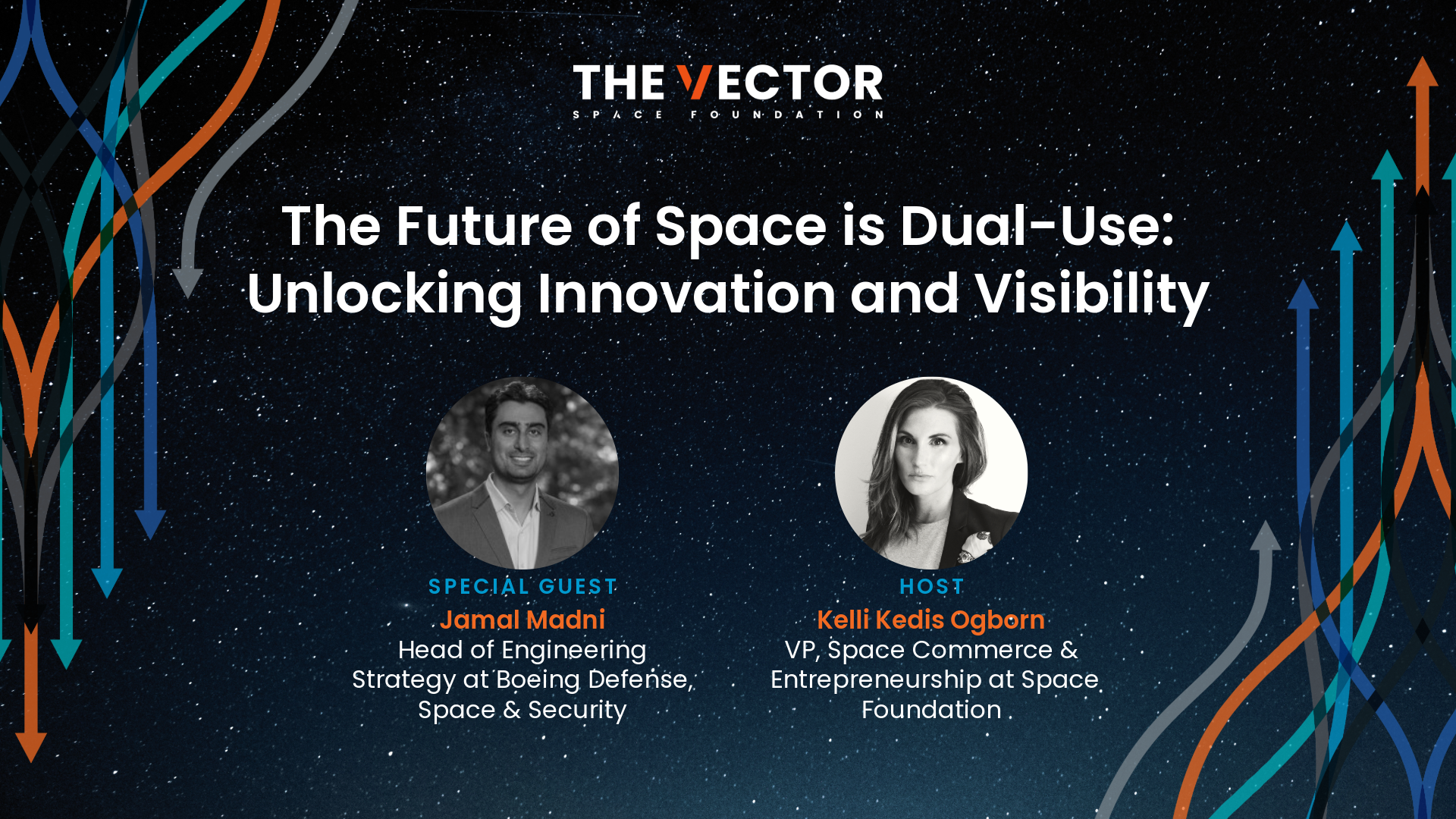
The Vector – Episode 28
Title: The Future of Space is Dual-Use: Unlocking Innovation and Visibility
Guest: Jamal Madni, Head of Engineering Strategy, Boeing Defense, Space & Security
In this episode, host Kelli Kedis Ogborn and guest Jamal Madni explore how dual-use innovation and supply chain resiliency are shaping the future of U.S. space competitiveness. From historical lessons of Cold War technologies to modern venture capital trends, the discussion highlights why supplier visibility, international partnerships, and the integration of small and mid-sized enterprises are vital in an era of strategic uncertainty.
Key Themes and Insights
Dual-Use as an Innovation Driver
- Many foundational technologies—AI, GPS, semiconductors, encryption—originated as military applications before transforming commercial markets.
- Dual-use is now bi-directional: technologies move from military to commercial sectors, while business models and commercialization strategies flow back into defense.
Evolving Government–Commercial Dynamics
- Historically, technology transitioned from government-funded R&D to commercial markets at late readiness levels.
- Today, relationships are multidimensional: government as funder, commercial as accelerator, and talent rotating across domains.
- Partnerships are most valuable in capital- or complexity-intensive technologies, where scale and integration demand collaboration.
Strategic Uncertainty and Agility
- Traditional planning horizons (1–5, 6–10, 10+ years) are compressed:
- Horizon 1: now just 1–2 years, shaped by fast-moving AI and quantum advancements.
- Horizon 2: 3–5 years, requiring scenario planning and assumptions.
- Horizon 3: 5+ years, long-term vision and competitive advantage.
- Agility—pivoting quickly to leverage disruptions—is essential to managing uncertainty.
Supply Chain Fragility and Visibility
- The pandemic revealed vulnerabilities: thin supplier margins, retirements of technical experts, and increased single-source dependencies.
- Solutions:
- Data-driven marketplaces that enhance supplier visibility across financial, operational, and technical metrics.
- Aligning incentives and building trust across primes, subs, investors, and policymakers.
- Shifting from adversarial cost-push relationships to true partnerships.
International Collaboration vs. National Security
- Collaboration boosts resilience and capability, but trust is the linchpin.
- The U.S. must decide between a closed “Apple” model or an open “Microsoft” model for space partnerships.
- With 93+ nations now operating satellites, collaboration extends beyond governments to commercial players, even as U.S.–China competition mirrors Cold War dynamics.
Role of Small and Mid-Sized Enterprises
- SMEs bring agility, innovation, and diversity into the supply chain.
- A healthy ecosystem requires thriving primes and a robust pipeline of startups crossing the “valley of death” into sustainable scale.
- Initiatives like the Golden Dome provide a North Star for anchoring product roadmaps and catalyzing interoperability.
Investment and Market Shifts
- Venture capital and private equity lines are blurring—investors want more active roles in operations.
- Space and defense tech require long-term, risk-tolerant capital beyond traditional 3–5 year return windows.
- Beyond billionaires, broader pools of capital and diverse funding structures are necessary to sustain innovation.
Both Kelli and Jamal stress that the future of dual-use innovation requires ecosystems of ecosystems: primes, startups, investors, governments, and international collaborators aligning incentives to strengthen resiliency. Success will depend on trust, visibility, agility, and the integration of SMEs into national security supply chains.
Episode 28 underscores a central message: dual-use innovation is no longer optional—it is the cornerstone of U.S. space leadership. Building resilient, transparent supply chains and fostering broad collaboration will determine how effectively the U.S. navigates strategic uncertainty in the years ahead.
Stay connected with the Vector Community!
Sign up for the Vector Newsletter for quarterly updates, stories, and news. Or subscribe to monthly episodes of The Vector Podcast, featuring space industry thought leaders and innovators. Join the conversation—help shape the future of space commerce.
Episode Transcript:
Kelli Kedis Ogborn:
Hello everyone and welcome to the Vector where we discuss topics, trends, and insights shaping the global space ecosystem. I am your host Kelli Kedis Ogborn, and today we’re diving into one of the most critical topics shaping the future of national security and space, supply chain resiliency from strategic uncertainty and global disruptions to dual use technologies and international collaboration, we’ll explore what it takes to build stronger, more transparent and more innovative supply chains. We’ll also look at the role of small and mid-size businesses, startups, and how new models of collaboration can contribute in strengthening our ecosystem and the challenges ahead. Joining me today is Jamal Madni, who is the head of engineering strategy for Boeing Defense Space and Security, where he drives strategic optimization across a global 20,000 person engineering organization. Before returning to Boeing, he co-founded Engaged Solutions, which is an AI ML behavioral intelligence company, later required by VidCruiter to improve equity and effectiveness in hiring worldwide at Boeing.
He has also led leadership roles in technology strategy m and a, due diligence and satellite systems spanning program management, r and d sales and software engineering beyond Boeing. Jamal co-founded Exit Velocity, a boutique m and a firm supporting small and medium-sized business exits and serves as an advisor to startups and nonprofits, including the UCLA Foundation and Climate Rights International. He holds dual master’s degrees in electrical and biomedical engineering from UCLA where he received the Rising Engineering Professional Achievement Award as well as an MBA from Stanford where he was named a Robert Joss Scholar. Jamal, welcome to the show.
Jamal Madni:
Kelli, thanks so much for having me. Really excited to be here and really a privilege to have a wonderful conversation this morning,
Kelli Kedis Ogborn:
Me as well, and I appreciate the duality of your background and your career because you’ve really seen this challenge set and this problem and evolution that we’re going to talk about today from all different facets. And so I’m really excited to bring your perspective and bring some knowledge to our listeners. And so just to start off the conversation, I really want to frame the concept of dual use because it’s always been, as we know, a really critical component to innovation and r and d, and particularly how the space ecosystem has evolved, but it seems that now it is more important than ever and it is definitely front and center of many conversations across the space sector. And so I’m curious from your perspective, why is it so important right now and what industries and technologies do you think are the most primed to take advantage of opportunity that is dual use?
Jamal Madni:
Yeah, Kelli, it’s a great question and I think to sort of answer where dual use technology is going, we have to acknowledge and honor the history of dual use technology and where we’ve come from. And I think the concept of dual use traditionally has been a philosophy that was really predicated from the Cold War era and then beyond the ability to take technology for military applications and be able to commercialize them into more sort of widespread markets and communities. And when we think about the successes associated with dual use technology over the last half century and beyond, we think about technologies like ai.
We think of technologies like autonomy, GPS, the internet, 3D printing, advanced semiconductors, and even software encryption. So a lot of what we are using today, the infancy and the bones and the architecture of which was really developed decades ago for various military applications. And so this idea of dual use has been a DNA and really an innovation elixir for our country as well as for our economy. And I think moving forward, Kelli, why it’s so even more important is unfortunately just given the geopolitical uncertainties of the world, it feels like we’re living in a more fragile world than ever. And I think the importance of using dual use technology are going to be even more prevalent. And I think the military has always operated on sort of two core principles. One is urgency and the other is secrecy. And when you put those two elements together, you create the ability to innovate very, very quickly, very, very creatively, and to be able to do so with a great deal of applications in mind.
And I think moving forward, that’s only going to be more exacerbated. Also given the fact that now the venture capital community is really looking at defense technology in a way that it truly hasn’t before, and it used to be 10, 15 years ago that defense technology, given the amount of regulation, given the amount of rigor given oftentimes a lack of transparency by design, those were difficult value propositions to be able to sell for large scale investment. Those lines are all blurring, those barriers are all coming down. And so now you’re seeing this massive influx of venture capital into defense technology. And then when you sort of couple that with the government thinking a little bit differently along the lines of business models and other transactional, what you’re really seeing now is a bi-directional dual use where technology is transitioning from the military to the commercial side, but the business model simultaneously are transitioning from the commercial side to the military. And when you have that bi-directional relationship taking place, that’s really where you can take a step function, jump in the innovation, and given the context that we’re in in the world today,
Kelli Kedis Ogborn:
That was such an eloquent response. There are so many aspects of that I want to unpack, and I really appreciate the historical context of dual use because you hit on many threads. One being a lot of these technologies that we’re seeing fielded now and come to fruition in the commercial world, and a lot of times we talk about tech transfer, but it either sits on the backbone of decades of investment and development in r and d or use cases like you said, in military applications that you may not need the full scale military application, but a component or a subpart or a way of doing something that finds itself into the commercial sector. And that’s why I think I love space so much is because when you dare to do hard things, you’re going to solve other challenges and problems and other industries that you may not have realized.
And I think that the heart and soul of what you really touched upon though was this bi-directional aspect, right? Commercial models spinning into defense applications and vice versa. And where do you see this trend really going? Because you can see the duality on both sides from a government aspect because commercial has been able to accelerate at such a pace, it makes sense to be able to use COTS technology or other innovations for new use cases. But then on the other end, the way that space is evolving and particularly a lot of growth in defense budgets and space really being seen as a critical infrastructure, that’s a really easy insertion point for commercial companies or new entrants to start there and then transition out. So how do you see that push and pull evolving in the coming years?
Jamal Madni:
Yeah, Kelli, it’s really fascinating. I think that that relationship is going to be, I think more dynamic and I think more multidimensional than it ever has before. And I think it used to be the case that they sort of operated somewhat in silos when you talk about technology readiness level where if I have an earlier TRL 1, 2, 3, 4, 5, I’m going to live on the government side of the house and then when I’m ready to sort of commercialize, I’m going to find one inflection point to then be able to transition to commercial. And that oftentimes was all the way to TL nine when I had a completely fully baked technology, or it could have been a little bit earlier. Now I think we’re seeing the relationship being very different. And I think there’s world where the government is the funder for various commercial companies in more of a venture capital type of model.
You’ve got also a relationship where commercial can play the role of accelerator for the government in terms of capabilities. I think you have a world here where there’s also an opportunity for talent rotation and the ability for top-notch engineers, technologists, strategists to play both sides and be in the commercial world as well as be in the military world as well. And so it’s very interesting, and then you can have just sort of genuine collaborative efforts of saying, we’re going to solve something really, really big. And as part of our product and technology roadmap, we’re really leaning on the government to solve problems X, Y, and Z, and we’re going to go ahead and solve problems A, B, and C. So you’ve got this really interesting, I think coalescence of two entities here that I think are leaning more into the various roles that they can each play.
And I think each relationship can be different. And so it’s a much more dynamic, I think, ecosystem than it ever has before. In some cases you’re funder and producer, in some cases you’re pure collaborator. In some cases you’re accelerator. In some cases you’re almost doing talent and knowledge transfer with each other. And so depending on the application, depending on the size of company, depending on the industry that you’re in, I think you’re seeing a lot more of these micro relationships develop. And I think that’s where you need things to go because the world is changing so quickly with the rate of technology. And then B, just how we think about boundaries is so different. I mean, when you just sort of take a step back holistically and say from a GDP perspective, you’ve got the US at 26 trillion, you’ve got China at 19 20 trillion, and then the third largest country GDP up until recently was Germany at 4.2 trillion. Think about the market capitalization of Microsoft and Apple and Google now nearing 4 trillion and beyond in Nvidia. And so you’re now in a world here where companies are larger than countries
When you compare GDP and market capitalization. And so the blurring of those lines really then creates a lot of interesting relationships. Now you have to sort of do those things responsibly and with a great deal of efficacy and care, but it really opens up the aperture on what you can do moving forward in a very exciting way. And I think the two fundamental pillars though, to really be able to build that partnership is you want technologies that are either capital intensive or B, complexity intensive. Because if I have something that I can build quickly and cheaply, I don’t necessarily need the partnership. I need the partnership when I’m attacking things from a scale perspective and from a complexity perspective to really do big hairy audacious things.
Kelli Kedis Ogborn:
Yeah, well, that’s where it really falls into a lot of this supply chain conversation because if we are going to build out this resiliency as a country and as a capability, I mean across the board you do need to have these partnerships in different ways. And I like what you said about the relationships might not necessarily look the same, and I don’t think they will. They won’t look the same because every path is different. And to your point, these multiple verticals kind of humming along in the same direction what these relationships are going to form in the future. And I think how the evolution of the ecosystem is going to evolve is really going to be telling. But I think there is one kind of common truth amongst all of ’em, and it comes into this concept of strategic uncertainty. I mean that term gets used whether you’re talking commercial, whether you’re talking government and across the board. And I’m curious, what does that word mean or phrasing rather mean for you, and how does this influence your role? And then broadly, how does this shape the way that the United States should think about innovation and supply chains in space?
Jamal Madni:
Yeah, Kelli, that’s the magical question there. Indeed. Strategic uncertainty is I think a concept that is really in many ways sort of a force multiplier moving forward when you think about things operationally, when you think about things technologically, financially and so forth. And I think uncertainty is a function of time. And when I think of strategic uncertainty in my role with my organizations and beyond, I have to time phase things. And traditionally we thought of those time phases as horizons. If you think of the traditional horizon definition, horizon one is maybe one to five years, horizon two is maybe six to 10 years. Horizon three is 10 plus years. And you want to be able to have an appropriate strategy for each of those horizons because if you are investing a lot of time and resources in just horizon one, you’re going to get more immediate returns, but at the expense of a long-term future and it’s shortsighted. If
You’re only focused on horizon three as an organization, you have to find a way to be able to keep the lights on and be able to operate in horizon one and two to get to horizon three. And so I think where that definition has really been challenged and been strained is now the rate of technology is so fast that you can’t think of horizon one as one to five years anymore. Horizon one now is one to two years,
Especially with the rate of change of so many of these technologies like ai, like quantum in particular and Quantum’s application in space. And then you think of horizon two as maybe three to five years and horizon three is five plus years. And then you try and invoke a strategy for those time phases. And in an ideal world, you have more certainty in the one to two year period, not complete certainty by any stretch of the imagination, but more certainty in terms of where the art of the possible is going to be with technology readiness at that point. Where are there opportunities for program insertions? Where is the world headed in terms of economic policy, political policy and so forth? And so you can be more crystallized in that 12 to 24 month period and then three to five years is you have a deep sense of what’s going on, but now you have to start adding in assumptions and it becomes kind of a multi-variable optimization problem there where you have a set of assumptions and those assumptions have a number of different possibilities and you try and scenario game things out as best to your knowledge.
And then five plus years is really where you see the world headed and where you believe you can provide the most value based on what your organization is really good at, what your organization has a decisive competitive advantage and where the need you believe is headed. And so I think of it in those types of phases and uncertainty in theory and in practice should be high or low in horizon one, that one to two years medium, three to five and then a little bit lower five plus. But with that sort of framework, you also want to have the ability to pivot quickly and you want to have deep conviction in your time phase strategies, but when something drops like a chat GPT or something happens like an incredible launch that really changes the art of the possible from a reusability perspective, you want to be able to pivot your thinking, your resources, your people, your technologies to be able to maximize. So what comes with the term strategic uncertainty I think has to be hand in hand with strategic agility. And when you have agility together with how you deal with uncertainty, that’s really where you can maximize opportunity for yourself, for your organization and for the country as a whole.
Kelli Kedis Ogborn:
Agility is honestly one of my favorite words, and when I do a lot of coaching with businesses, I tell ’em that really the only true business strategy is the ability to pivot and to be able to look at the landscape obviously tactically, right, but be able to know when there might be a major disruption. Like you said, the pace and scale and acceleration of certain tech verticals may also accelerate your horizon one and make you then push it forward. And I’m just curious as lessons learned, because everyone around the globe has this experience, but did we learn anything from the global disruption that we’ve seen in terms of pandemics or geopolitical tensions about this supply chain resiliency and ability to pivot? What lessons can be gleaned from that time?
Jamal Madni:
Yeah, Kelli, it’s a great question and it’s an area that I’ve spent a lot of time thinking about from various aspects of my career. And I think what the pandemic showed us particularly was how fragile our supply chain ecosystem is because I think when you see the challenges associated with the supply chain of aerospace and defense, let’s say what you saw in the pandemic was you had a supplier base in a lot of cases that was operating, that group of companies were operating at pretty thin margins. And once the pandemic came about, the vast majority of tier three, tier four, tier five suppliers either unfortunately went out of business or their technical experts, their quote, gray beards if you will, decided this is the opportunity for them to retire. And they lost a ton of knowledge. There was a brain drain there. And so what you were left with on the other side of the pandemic was a number of single source situations from a supply chain side and a number of now suppliers that either got much younger from an experience and a knowledge standpoint overnight or went out of business altogether.
And so you had to kind of create a world where you had to sort of requalify suppliers. And that led to I think a lot of development challenges across the industry naturally. And so this idea of moving forward, how do we create a more resilient supply chain? I think in a perfect world, you have to be able to align incentives with technology. And what I really mean by that is from a technical standpoint, I think there’s a way we can go from a visibility standpoint of the ability to create marketplaces with data of your suppliers. And that data could be financial, operational, programmatic, technical, and the ability for folks and primes and integrators and folks further up the supply chain to be able to go further back into their supply chain and use data to then be able to make informed decisions and be able to look around the corner and assess issues before they become a reality.
Because once you have the data, then you have an opportunity to have a layer of intelligence on top of that data, do pattern recognition, understanding characteristics, understanding clusters and so forth, and then get to a world of prediction and forecasting of saying, Hey, my supply base in this particular subsystem or in this particular vertical is challenged. How do I work around that? How do I either provide investment to that supplier base? How do I build capability internally? How do I establish partnerships? How do I go and do that? But in order for that technological ecosystem to take place, you have to align incentives. And I think what we saw historically with the supply chain in particular is oftentimes folks upstream in the supply chain push down risk, push down cost,
Push down complexity into their suppliers. And so it creates more of an adversarial relationship than it should. And at the end of the day, we’re all collaborators on being able to provide a capability for the nation, for our markets and so forth. And so I think we have to think more from a partnership standpoint and create the incentives to be able to align those expectations. And then once those expectations are aligned and you have trust in the ecosystem, then bringing data and intelligence to a marketplace that is predicated on trust, you’re going to see a ton of magic happen. And I am really excited to see where supply chain visibility goes moving forward from a startup perspective and innovation perspective because it’s such a huge problem that there’s so much opportunity there for creativity and new ways of thinking moving forward. It’s a big problem.
The scale is massive there, but people coming at it from a technology perspective, from a behavior perspective, a psychological perspective, human computer interaction perspective, a social perspective as well are all going to be necessary solutions as we move forward. And as we think about even where we see the world, how a tariff or a certain policy can create unrest in a supply chain is very, very paramount here. And so what we’re seeing is a supply chain that’s very powerful, but it’s very fragile, and so that really creates a lot of opportunity to make that resilience happen.
Kelli Kedis Ogborn:
I have a two part follow-up question for you, and they’re slightly divergent themes, but they both play on this what you just said. So the first piece about just the fragility, and I want to say the fragility, the complexity and the challenges that exist in the supply chain now is the reason for that just there hasn’t been the necessity to build in resiliency and that we’re moving into a new era. So that’s the first question. The second question is around your point about being able to build trust into these systems and be able to have shared risk and really this incentive model, because when I hear that, I think of it’s beyond the supplier, like the prime and the sub, but it also comes into the investor and the stakeholders and sort of everyone. So to build that out, what does that take? Because that to me makes it seem like you need to get all of these people stepping up to the plate to understand the prime problem, but they all speak different languages, different mission sets, different ROIs. So that’s the second question.
Jamal Madni:
Yeah, Kelli, it’s a great question and I think the reason for the fragility of the supply chain in terms of the first part of your question just has to do with the nature of how complex the systems end up being at the end of the supply chain. Exactly. When you talk about airplanes or satellites or rockets or missiles or fighter jets or unmanned vehicles and so forth, these are such complex systems that require so much integration and so much alignment technically, it really is a marvel of the human condition in so many ways, and it’s why folks like you and me are just so honored and excited to be in the space industry. But if you peel that back, what that requires at a subsystem or a component level is a deep degree of domain knowledge and domain knowledge takes time to acquire, particularly when you’re dealing with longer product cycles.
Now with technology, we’re shrinking those product cycles, but we’re never going to get to a place of these products having the life cycles of say, software where because you have to have integration and test milestones, you need to have certification milestones, there’s fundamental gates that you have to pass to be able to have a system that is that ready for a mission critical environment and being safety critical. And so when you sort of peel that back at a supplier on a component level, it takes time building that domain knowledge. And oftentimes that domain knowledge is sort of hard to come by because oftentimes the rate at which you are building a certain product, it does not follow commercial curves. I mean, even when you think about satellites, now we’re in a world with Leo where we’re going into hundreds and thousands, but prior to that, even 7, 8, 10 years ago, the largest constellation was 6, 8, 9 satellites.
And so you just don’t have the rate to be able to scale that domain knowledge quickly. And so I think moving forward to make that more resilient, I think you have to do a couple of things. One is you really have to emphasize knowledge transfer both within at the inter-organization level, but also at the int inter-organization level. And so I think the opportunity for knowledge transfer solutions is really greater than it’s ever been. And second, I think companies need to think about geographic placement differently. And oftentimes large companies want to be more global, but what being more global looks like is having a satellite location in a different country. But I think we need to flip that model. And oftentimes that location is sort of in service to the mothership in the United States if it’s a US-based company and how can that location kind of serve the needs of a US-centric market? We have to flip that narrative and say for these companies to be global, it’s about placing their corporations, their brands, their strategic advantages into other countries, but letting those locations lead markets and lead technology innovation and use the mothership to help enable and unlock that. And so if you can create an inversion model there, now you’re creating more nodes in your network that have the same amount of capability and have the same ability to be. I think oftentimes what happens is we sort of say, Hey, widget maker, a stays widget maker A,
And if something happens to that widget now they lose all value completely. But if you have the ability to be cross-disciplinary, then you can sort of take things to the next level. And I think Kelli, to your second point of how do we sort think about supply chain visibility kind of moving forward and what needs to change particularly moving forward from an incentive standpoint is we have to think about this at a system level and what are the economic implications? What are the behavioral implications? What are the political implications to align our supply base? And this is I think where a role where you need government to step in here and say, what is most healthy for the country? What is a healthy supply chain look like? And what are the policies that you can have for tier three, tier four, tier five suppliers, as well as your primes in your integrators to be able to incentivize things?
What can you do from a tax perspective? What can you do from a jobs perspective and a jobs placement perspective? What can you do from a data rights perspective? What can you do from a licensing perspective? And then what can you do to allow people to have that social and economic mobility to play in different pieces of that supply chain? So I think we need to think about it much greater, and whether that’s a coalition, whether that’s a consortium, whether that’s the government, I think it’s going to take more than just one or two companies. It’s going to have to be the industry at hold that comes together and thinks of this in a systemic way.
Kelli Kedis Ogborn:
It’s such an important point to make because systems of systems, people within the tech world know that. But really what we’re talking about is ecosystems of ecosystems and in different ways because I think that often when you’re building out technology, you can look down the pipeline and think of these secondary and tertiary orders of effect, but it’s generally from a technology capability, usability level, and to your point, it’s looking externally to these seemingly esoteric aspects but that are just as critical to the tech development because that’s really what’s going to get public adoption, more funding, integration, it’s all the other stuff that can hinder the ability to grow and the capability of the supply chain with the tech still being good and people sometimes don’t piece those worlds together. But to your point, it’s so intrinsically important to this growth pattern that we’re starting to see or not that we’re starting to see that we need to see through rather
Jamal Madni:
No question about it. Kelli. And it reminds me of when I started my first company Engage. You sort of alluded to it in the intro, and we were an AI L company in term from a technical standpoint, but we didn’t market ourselves that way. We said we’re a behavioral company that happens to use artificial intelligence and machine learning to meet these needs and meet our vision and meet these objectives. And I think we have to sort of think of technology being an enabler to larger outcomes rather than just being technology first. Because now as we see the blurring of the lines of technology really becoming more and more intimate with our lives on a day-to-day basis and how we interact with that technology now, that ability and that interplay of the human and the emotional with technology, I think is going to be more and more paramount moving forward. And so we have to sort of think beyond just the technical solution, which is so necessary, so important, fundamental research, innovation, all of those things. But now it has to be in service of what, and there has to be sort a human element on the other side of what technology is in service of. And I think that’s where it gets so interesting in terms of the types of people that we need to solve these problems. And I think there’s so much conversation right now on where’s the future of jobs and where’s the future of capability really going?
But I think now more than ever, we need critical thinkers more than ever, and folks that can look at things from multidimensional multidisciplinary lenses and be able to play in those sandboxes equally effectively. I can play in the technical sandbox, I can play in the behavioral sandbox, I can play in the political, the economic, the social and be able to create bridges of alignment across those sandboxes. Those are the types of thinkers and individuals we need more than ever, whether in government, whether in private industry or whether at the intersection of those two things. In terms of thinking of these things in a more holistic way, think tanks and organizations such as the Space Foundation,
Kelli Kedis Ogborn:
No, a thousand percent, it’s the connecting the dots and moving things forward. And to your point about the broader holistic approach and ecosystem, I do want to come back to what you were talking about in terms of international partners and international collaboration because as you mentioned, there is this necessity to be collaborative as we are growing. And to your point, companies should consider putting headquarters or putting manufacturing facilities, but letting that country lead completely agree. I’m curious though, putting our US hat on, and particularly as we’re moving into this environment where space is a critical war fighting domain, it is becoming more contested than we’ve seen in decades. How does that international collaboration piece in building resilient supply chains affect our national security apparatus? And this can be in terms of thinkings parameters, kind of however you want to take this question.
Jamal Madni:
Yeah, Kelli’s such a powerful one because in theory, collaboration is one of the fundamental building blocks you have to build resilience because I’m either just from a purely logical perspective, if I have trusted collaborators that are building supplementary capability in technology or complimentary capability in technology, that fundamentally makes me more resilient because if something quote wrong with my operation or the way I do things, I can now have someone else I can tap into and still be able to meet my objectives. So collaboration is fundamental to resiliency. And furthermore, if I collaborate, not only do I build that redundancy, but now I can also do more. And so in theory, that is a fundamental building block. Now in practice, it’s predicated on a fundamental assumption that that collaboration is an enduring collaboration and that partnership remains a partnership in perpetuity and the ability to sort of determine that I think is more interesting than it’s ever been.
And I think how you build trust with collaborators moving forward is really going to be interesting. And we’ve always kind of used it. We’ve used political systems as a proxy for trust where hey, if you have the same political system that I do, we think of the world similarly, we have a similar point of view. And so it’s sort of natural for us to collaborate versus folks that maybe have another point of view on how a country should be governed or a region should be governed and whatnot. And that’s been a proxy more for difference unfortunately than anything else. But I think we have to sort of extend that definition as well and think beyond that of social implications, economic implications and so forth. And I think that’s where things become very, very interesting. Is my friend today, is that going to become my enemy tomorrow or vice versa?
And so if the level of trust, the level of trust and the level of collaboration go hand in hand, and it’s a seesaw, if my level of trust is down in others, then it’s going to make me more vertically integrated as a country and because I have to sort of rely on myself completely. And then what are the implications of that, of having everything built in and being a closed model versus saying, okay, my level of trust is going up so I can be open to collaboration. The analogy there, Kelli, on a much smaller level, but a powerful one was the difference between Apple and Microsoft in the nineties and the two thousands, right? Apple went closed system and said, in order to play with Apple products, you have to have Apple products. And Microsoft was much more open and said, we can sort of play and plug accordingly. I think as a country we have to think about do we want more of the Apple model or do we want more of the Microsoft model and what the implications there are. I don’t know what the right answer is because the world is changing, but you have to have an answer.
Kelli Kedis Ogborn:
I think that’s a perfect analogy, especially as we look at Artemis versus ISLR and these coalitions that are emerging. And I think what’s an interesting point that you made just about how allies and partners in collaboration traditionally is seen, but also how it’s grown is going back to what you said in the beginning about dual use coming out of the Cold War. And at that point there were two superpowers. We were battling for space dominance and space supremacy, but now there’s over 93 countries that have an active satellite in orbit. And so it’s a very different environment and you’re not just engaging with government entities, it’s now commercial aspects and it’s just a very different playing field. So your analogy was very, very well put in terms of the choice and the systems approach to it.
Jamal Madni:
No question, Kelli. It’s going to be sort of an interesting time and thank you for saying that, but it’s going to be an interesting time moving forward because it’s so interesting as much as the world has changed to your point in terms of now 93 countries, what a staggering number and what a celebration of innovation in the human condition. And so it creates such a different ecosystem at the same time. If we look at the Cold War versus today, well, it’s still sort of two superpowers battling it out. It’s just a different superpower. It’s a different country now. Now it’s the US and China. And so history in many ways is repeating itself from a behavioral standpoint of that supremacy. And rather than the Cold War being a pure race to space, now it’s all about the race to ai, the race to quantum, and the race to the ability to create compute. And the country that wins computation is really probably going to be the country that has that supremacy and its computation. The form factor that computation can take that is truly disruptive moving forward to your point is in the space domain. And so that’s where it all sort of comes full circle in this beautifully elegant way
Kelli Kedis Ogborn:
And the fact that we need more and more capabilities, to your point, that’ll be able to allow us this robustness and resiliency. And I’m curious, when you look at the landscape ahead, how do you see smaller and mid-size enterprises fitting into this national security and space supply chain ecosystem? And then on top of that, how does the Golden Dome Initiative play into this, influence it, et cetera?
Jamal Madni:
Yeah, Kelli, I’m so excited about the ecosystem right now, and I think small and medium sized companies play an instrumental role. And I think when you think about the ecosystem, not speaking for anyone, but from my experiences, from my positionality, my intersectionality both personally and professionally, I think a healthy aerospace and defense ecosystem is a world where you have your primes and that your primes are thriving. Your Boeings, your Lockheed Martins, your Northrop Grummans, your tier one subs we’ll call them, are also thriving. Your Raytheons, your L three harrises, your BAE systems,
And then you have a group of startups that are also thriving in a significant way, a dozen, two dozen, three dozen of them that sort of cross the chasm and really become key trusted partners with the government moving forward. I think if you can build that ecosystem in a perfect world, that’s where you want to be. And then those startups sort of move up the chain and become primes themselves and become really at the front edge of supply chains and systems integration and whatnot. And I think that creates a lot of health. I think that creates a lot of excitement, a lot of innovation, a lot of competition, and I think that’s where you want your ecosystem to be. You don’t want to be in a place where it’s the same 3, 4, 5 companies getting all of the contracts because that creates more monopolistic type of industries, which aren’t very good when it comes to pushing the envelope then because when you’re in a more monopolistic situation now you’re dictated by the processes and the philosophies of just a handful of companies and a handful of people, and you become more fragile again to innovation in some pockets.
So small and medium sized companies play a paramount role, and I think the appetite to have them in the ecosystem has been greater than it’s ever been. I would argue in the history of defense tech and in the history of Space Tech right now. And I think the things that SpaceX has done has been remarkable. You’ve got Andel, you’ve got Palantir, you’ve got ciran, you’ve got Shield and just many, many other companies. And I think it’s all for the benefit of the ecosystem. And I think what the Golden Dome, Kelli, to your point is providing is a bit of a North star. It’s giving you sort of a north star on where you perhaps want to anchor your roadmap because I think the history of space innovation, defense innovation has been a number of activities that are going on in parallel a number of things.
You’re going after certain acquisitions, you’re going after certain program offices, you’re going after certain constellations. The Golden Dome hasn’t been a terribly new concept. It’s been something that’s been around since really the Reagan era, to be honest with you. It’s been sort of marketed differently now, but it’s giving you that opportunity to sort of have a North star and saying, Hey, can I have, and a constellation of capability both from terrestrial to air to space and be able to have an objective so you can sort of anchor your product roadmaps and your innovation life cycles accordingly. And so it’s a really interesting time, Kelli in the world today. I will also say that there is also going to be a bit of a litmus test with a number of the startups and the small to medium sized companies because at the end of the day, when you think of entrepreneurship, there’s really only two forms of exits. You either go m and a or you go IPO
And to go m and a. You still have a finite number of companies that are in a position to buy technology at that scale and at that quality. And the rigor in today’s day and age to go IPO from a revenue standpoint and a profitability standpoint is higher than it’s ever been. And so it’s going to be really interesting to see how the small companies and the startups think about that and how they get on the other side of that because a number of smaller companies have done a phenomenal job of being able to raise capital based on a founding team that has had exorbitant success in other industries or in the space and defense industry, been able to really have a significant amount of capital, be able to invest in capability, but also buy capability. And then that ability then to cross and go from a world where you’re putting capability together but then get to a place of high rate either manufacturing or high rate in terms of productionized software, that jump is still in front of us. And I think it’s going to be fascinating to see how some of these companies do that and who kind of makes it to the other side. So ton of excitement, ton of intrigue, and a ton of mystery frankly, with the future of defense tech and Space Tech.
Kelli Kedis Ogborn:
I share that same thought. I think your point about Golden Dome, what’s nice about it being that North Stars, it’s also a North Star that’s looking to utilize existing capabilities and really kind of catalyze this systems as systems approach because particularly on the timeline that they want to test, I think the first test is supposed to be like October 20, 28 or somewhere around that timeframe. You really need to be able to look at integration, interoperability and some of these supply chain technologies that can feed into the larger, and to your point about the growth aspect of some of these companies that have been able to raise, I think the scale to your point is going to be what’s going to be interesting to watch because we need diverse capital sets and different risk thresholds, quite frankly, that we’ll understand that this technology may not yield a return in three to five years, but it’s going to be such a critical linchpin to what we’re trying to achieve as a country. And so I’m really encouraged to see a lot more diversity of capital formation come into the ecosystem globally too, just understanding that there’s not only the opportunity within space, but the necessity of it. And I’m excited every time I see someone else kind of peeking their head up, I’m like, yay, join us. We need you.
Jamal Madni:
No question about it, Kelli. And sort of to that point, it is the perfect confluence of investment with technology, with partnership right now because even in terms of the larger investment community, we’re at a moment here a little bit with venture capital and venture capital is thinking about how to redefine itself. And that line between venture capital and private equity is softer than it’s ever been. And now venture capital wants to sort of step up and say, Hey, I just don’t want to invest in a company. I want to acquire companies. I want to operate companies. I want to have more skin in the game. I want to really roll up my sleeves. And that lends itself so beautifully to space companies and defense companies of say, Hey, to your point, Kelli, come join us.
Bring investment, but not just your treasure, but your time and your thinking and your perspective along with your treasure because we’re building something so great. And then help us in terms of that advocacy of being able to determine how we can sustain on the other side of it. Because we’re now kind of getting to that world where hopefully investment in space is also more accessible than it’s been in the past. Because truthfully, what Elon did with SpaceX is sort of one of one market. It’s a use case to be able to stay private, to be able to have a secondary market of shares. The ability to do that really is you either have to be the richest person in the world or the second richest person in the world. So we’ve seen Elon and Bezos with Blue Origin sort of play that game. I mean, I think of someone even like Richard Branson who’s just such a wildly successful entrepreneur, what a legacy he’s had, but even he doesn’t have the deep enough pockets to sort of sustain a space company, which is sort of staggering to think about a billionaire, a decorated individual like Richard Branson almost said, Hey, this is a little bit too rich for my blood.
I’m going to need some outside capital here to be able to make this work. So that’s where it takes a village to be able to do this in a meaningful way. And I think we’re starting to get all the nodes together to be able to point in that direction. What an exciting time.
Kelli Kedis Ogborn:
I completely agree. I’m really excited to see what the ecosystem looks like 3, 5, 7 years out, and I’ve really, really enjoyed this conversation. Jamal, thank you for sharing your intellectual treasure and your time with us. I think there was so many truth bombs and notes of information for our audience, so thank you again for joining us.
Jamal Madni:
No, Kelli, it was an absolute pleasure. Thank you so much for having me. It’s such a fun conversation and would love to do it again at some point.
Kelli Kedis Ogborn:
Absolutely. This is one of those where we’re going to have to take the temperature check and see where the evolution of the ecosystem has gone with some of this supply chain. So we’ll definitely do that. And to all of our listeners, thank you again for tuning in. And remember, there’s a place for everyone in the global space ecosystem. We’ll see you next time. Bye.
Related Articles

Listen to the Podcast
The Future of Space is Dual-Use: Unlocking Innovation and Visibility