
Transcripts
What You Missed On The Vector Episode 29: Space Investment Analysis: Growth Across the Global Space Economy
Written by: Emily Normandy
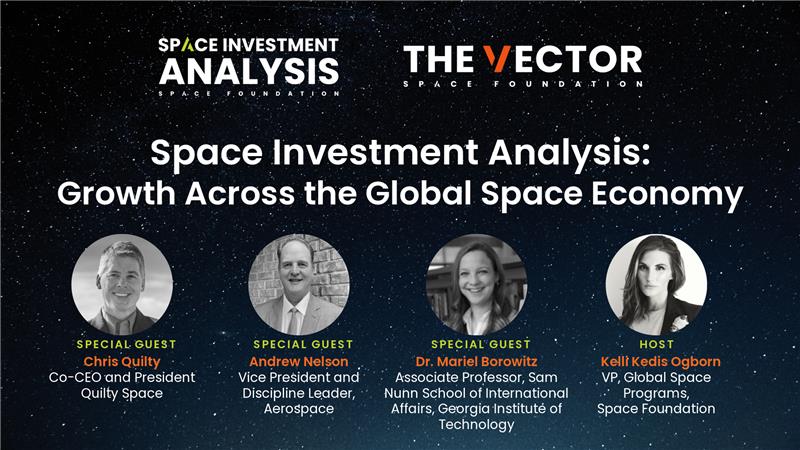
The Vector – Episode 29
Title: Space Investment Analysis: Growth Across the Global Space Economy
Guests: Dr. Mariel Borowitz (Director, Center for Space Policy & International Relations; Associate Professor, Sam Nunn School of International Affairs, Georgia Tech); Andrew Nelson (Commercial Space Leader across policy, tech, regulatory, and investment); Chris Quilty (Founder & Partner, Quilty Analytics)
In this special Space Investment Analysis Series edition, host Kelli Kedis Ogborn convenes a seasoned panel to unpack what the latest Space Report signals for the next phase of industry growth. From mounting launch bottlenecks to the geopolitics of lunar return, the discussion explores how capacity, standards, public–private financing, and international dynamics will shape the global space economy, now and over the next decade.

Key Themes and Insights
Launch Capacity Is Hitting the Limits
- Record cadence meets real-world bottlenecks. The FAA’s thousandth commercial launch milestone underscores rapid growth since 2021, but operations at major ranges increasingly block each other across pads; adjacent infrastructure—wastewater, bridges, rail, ports—is straining.
- National security imperative. Capacity vs. necessity is now a defense issue, not just logistics. Launches must stay “on cycle” to serve commercial and government timelines.
- Standards & interoperability. Moving toward airline-like operations—standardized fixtures, fueling, and data paths—could dramatically lift cadence.
We Need More (Smart) Spaceports and Local Buy‑In
- Concentration risk. ~98% of U.S. launches come from two sites; resilience demands additional spaceports beyond the Cape and Vandenberg.
- Community engagement. Not just more spaceports, but the right ones. The Camden, GA case illustrates why early local engagement and environmental clarity matter.
- Alternative models. Sea‑launch concepts, municipal tools (e.g., bond funding), and targeted environmental categorical exclusions can expand capacity without overburdening ranges.
Financing and the Role of Government
- Spaceport financing is hard. Traditional infrastructure investors struggle with demand signals for novel spaceport assets.
- Public–private paths. Government guarantees, backstops, and subsidies may be needed to unlock capital; anchor tenancy and facility co‑funding can de‑risk builds.
Balancing National Security with Commercial Growth
- Policy agility. The U.S. can speed licensing and government processes to capture existing private capacity.
- Industrial policy via demand. DoD’s approach: multiple winners, proliferated LEO, and rapid‑turn launches, builds the base by being a strong first customer.
- Allies and redundancy. Europe and others are developing sovereign capabilities; stitching these into a resilient Western ecosystem will be key.
Moon: Speed vs. Sustainability
- Being first matters but so does staying. The “race” is about durable presence and who builds and maintains capability.
- Early priorities. Power, communications, navigation, and space domain awareness are the first building blocks; ISRU and surface industry follow on longer horizons.
- Government as a catalyst. Clear rules of the road, anchor missions, and milestone‑based contracts can crowd‑in private investment.
Concrete Lunar Infrastructure Needs
- Surface basics. Roads, power grids, water access and processing, inflatable habitats protected by regolith berms, and construction “bricks and two‑by‑fours” approaches.
- Economic trigger. Sustainable presence ultimately hinges on profitable use‑cases (e.g., in‑space biopharma manufacturing), even as longer‑term plays (e.g., ISRU) mature.
Both Kelli and the panel emphasize that the next inflection point will be defined by capacity (launch sites, standards, infrastructure), clarity (policy, rules, financing), and coalitions (public–private, allied ranges, and community consent). The winners will design for scale, invest in foundational systems, and couple national priorities with commercially viable business models.
Stay connected with the Vector Community!
Sign up for the Vector Newsletter for quarterly updates, stories, and news. Or subscribe to monthly episodes of The Vector Podcast, featuring space industry thought leaders and innovators. Join the conversation and help shape the future of space commerce.
Episode Transcript
Kelli Kedis Ogborn:
Hello everyone, and welcome to a special episode of The Vector as we bring you the Space Investment Analysis Series, a quarterly discussion where we dive further into the latest space report and dissect the important topics and essential information in moving our industry forward. I am your host, Kelly Kedis Ogborn, and like always, I am joined by leading experts who bring context and perspective to the evolving dynamics of the global space economy.
On the show today is Mariel Borowitz, who is the director of the center for Space Policy and International Relations and an associate professor at the Sam Nunn School of International Affairs at Georgia Tech. Andrew Nelson, who is a commercial space leader working with senior corporate and government officials across policy, technology, regulatory and investment domains. And Chris Quilty, who is the founder and a partner of Quilty Analytics, an independent boutique firm providing subscription research, strategic advisory and investment banking services spanning every facet of the satellite and space industry.
Welcome to the show. You three.
Mariel Borowitz:
Thank you. Thanks.
Andrew Nelson:
Hi, guys. Thanks.
Kelli Kedis Ogborn:
First of all, I love getting the gang back together. You know, we have a new case recently with this report and where I really want to focus. Today’s discussion is looking at all the various forces that are shaping space. Next phase of expansion. So we’re going to be talking about capacity, ambition, you know, talent investment, which are all really critical areas to not only defining the boundaries of capability, but also really setting this pace of progress that we’re seeing push forward.
And as an industry, I’m sure you agree with is that it seems like we’re really quickly reaching our next inflection point and that the decisions that are going to be made in the next 1 to 2 years will echo in the decades to come. And so I’m really excited to dive into these, these conversations and get your perspective.
And, Andrew, I want to start with you from like a framing perspective, really looking at, you know, infrastructure in this capacity and necessity because, you know, this past quarter’s data really paints a very clear picture that capacity and necessity are now really kind of running in parallel. And this is really kind of no longer just a logistical challenge.
It’s now a national security imperative. And what we saw in this report is that the FAA recently marked its thousandth commercial launch, since its 66 years in existence. But the volume of launch has continued to hit record highs every year since 2021. And so the growth is extremely remarkable. But it’s also a bit revealing. And I feel that opportunity is sort of testing the limits of today’s infrastructure.
And so I’m curious from your perspective, how serious you think this bottleneck is and what might be some of the most effective ways to expand physical capacity sustainably, but also ensure we’re able to launch on cycle and keep up with demand?
Andrew Nelson:
Sure. Well, I can attest, the constraints are real. And they’re getting worse. Much larger rockets at places like the Cape, are causing, issues with processing of other rockets or will cause process, issues of processing rockets on neighboring pads, even though they’re a couple of miles away. You already have today, operations on one pad, impacting another.
If you go up to and look at Wallops Island pads, they’re right on top of each other. Very close. Clearly, when one is, you know, doing a critical operation and the other one can’t. You have other regulatory constraints, like on the West Coast with the California Coastal Commission limiting commercial launch out of R&D. You’ve got, infrastructure challenges to get larger rockets out of Alaska.
And then you have basic fundamental infrastructure challenges at places like the Cape where you don’t have any more capability for wastewater treatment. You know, the basics. The bridges need to be expanded. They need more railroad capacity. They need more port capacity. So these constraints are definitely real. And, so, yeah. And of course, there’s some tools that have been put in the toolbox recently with, you know, municipal bond funding and, you know, the executive order for categorical exclusions to speed environmental, places in certain circumstances, not all.
So but, you know, infrastructure funding is needed. Congress needs to allocate more money to a space port. Bottom line, more payload processing facility. These are all bottlenecks.
Kelli Kedis Ogborn:
So, yeah. Have you seen anything? Or any recommendations and sort of open to anyone about sort of effective ways to expand physical capacity lessons we can learn from the industry, the bottleneck.
Chris Quilty:
I don’t think there’s a lot of good solutions on the table. I mean, when we come down to, basic geography, and inclination angles, you know, the ideal place to launch is along the East Coast, unless you’re launching to a polar launch, which we do from Vandenberg and, namely a place on the East Coast where we can add more capacity.
And we do need to because, I mean, if you look at the situation with the spaceports, we basically have you know, 98% of all launches going out of two sites. The Cape, you know, has expanded beyond what they thought was possible. You can go back to 2019. A Space Force said they they thought they could theoretically launch 50 times a year.
Native, halfway down two weeks for maintenance. Well, I mean, we launched 90 times last year, so kudos to them, right? They’ve ramped up, but that’s all before. Blue Origin has come online and Vulcan is come online and Firefly and you know my goodness you mentioned that Andrew. But but Starship that takes a nuclear bomb like we saw it go off, right?
I mean, how are you going to process things there? So I think the fundamental issue that we have to solve is we need more spaceports. And unless, like the Chinese and Russians were willing to launch England and drop stages, you know, on down, down, downrange cities, there needs to be some other locations. And I think what what we’ve seen is, you know, organic ability or attempts to do that, like they did in Camden, Georgia, were shot down by, you know, a Nimby sort of, you know, voter.
You basically had 4000 people in, in Camden County, Georgia, that shut down this what would have been an alternate launch site on the East Coast. And that’s really too bad because they had spent a lot of money. They had actually had an FAA launch license out of there. I mean, it’s a Union Carbide gray site. Like, what the hell else are you going to do with it?
But it did have deepwater port and it had a railroad. And, you know, unfortunately, because it over flew, you know, an uninhabited island that has turtles on it, you know, we, we don’t have or don’t launch. I’m glad to see that they’re ramping up in Wallops, but that ain’t a solution. I mean, look at the air corridors there through Philadelphia and Baltimore and DC and New York.
And it’s a I’m an 80 guy. It’s a Navy range. Right? That’s not their priority, in space launch. So I think, unfortunately, what we’re seeing is, to, to build redundancy, you know, DIY you specifically has been working with the Australians with a technology safeguard agreement that’s already in place. And we’re also seeing, Firefly, you know, has now, signed with.
God. I’m going to get it wrong. Is it was it and or, the strange range, but, you know, they’re going to Europe. And that is happening in Europe, where they were fully dependent on the single site in French Guiana. And you’re now seeing a plethora of sites that are populating across, you know, across Europe.
So I think that’s part of the problem that needs to get resolved. And unfortunately, that’s more of a, political, than, an economic issue that we have to resolve.
Andrew Nelson:
Yeah. And on the point of, oh, going.
Mariel Borowitz:
I was just gonna build on those comments a little bit as well. You know, I, I think it’s a really interesting point, you know, the need to expand the capacity, although I would also emphasize, you know, we have spaceports that are, you know, were developed, funding put in and aren’t being used. Right. So it’s also building the right spaceports, right, types of spaceports in the right locations, as Chris kind of mentioned as well.
And I think the Georgia, example is another one, you know, being here at Georgia Tech, we were following that very closely, and was an exciting prospect for a lot of our students to have a spaceport right there, potentially. And I think one of the lessons learned there is just the importance of working with the local community, because I think there were people who legitimately worried, you know, there’s going to be debris raining down on our heads or on our on our area.
It’s going to be a, you know, ecological disaster. And I think actually the space community has good safeguards in place, has good analysis that we do to ensure that that’s not the case. But I don’t know that that message always got across to the individuals on the ground living in those communities. And so yeah, it all to me was a, you know, a referendum by the local community that that stopped that development.
Yeah, probably a loss, a loss there for Georgia.
Andrew Nelson:
Yeah. Well, I mean, Chris can tell you I was involved from day one on that one until the very end. Almost. So, I could give you two of these things, but, Chris is right. We need more launch capacity. We need more launch sites. And the Inland orbital launch opportunity, I think, is quite good with first stage landings.
Whether the, back at launch site or downrange. Second stage reusability, driving up the, reliability numbers on especially first stage launch and and landing precision. You know, we’re potentially 8 to 10 years away from, you know, almost general aviation levels of safety and rocket launch that would open up in the normal launch. But the other piece of this is based, you know, sea Launch, we have 2 or 3 competitors that are now in the US and they can go out of ports.
I’m here in Puerto Rico today. They want to have vertical launch. I want to have horizontal launch. And going out of Roosevelt Road Harbor is very easy to do. That’s an option for Wallops if they can figure out how to dredge the Chesapeake without upsetting everybody. You know, Port Canaveral wants to do their rocket Marina.
And, you know, so there are solutions. But, you know, what’s the old saying? No bucks. No bucks. Rogers. The money.
Kelli Kedis Ogborn:
It’s true. And I think what’s interesting about this, where this conversation very quickly went, is it’s yet another issue of narrative. Narrative sort of beats out necessity. Right. And just the lack of understanding and then the whole need for political will. But underpinning it all, Andrew, it is the need for capital because beyond if you set the conditions and the parameters and have the facility, how do you actually fund it?
And and Chris, I want to come to you for this one to sort of start off this question, because what we’re also seeing, you know, the the global sort of global rise of some of these spaceports, but also a lot of states now, whether they are reinvigorating a spaceport that they already had or they want to develop one, really starting to figure out funding models and putting at least capital or the will to put capital toward these.
And so, how do you see the potential of these public private partnerships really evolving to allow this launch infrastructure to be more efficient and really less costly in the run to allow for the capacity of launch?
Chris Quilty:
Yeah. Spaceport financing is a difficult creature. You know, when when you’re in the finance world, I mean, hopefully we all know the difference between an equity and a and a fixed income, but even the types of investors that want to invest in projects like this, you know, these are a typical infrastructure investor. You know, if you’re investing in railroads, right, you know, you’re going to get 50 years out of this.
And the sort of demand picture for this service, right, has never been really done in the private domain. So the investment community has a really hard time wrapping their arms around it. And this is where, you know, I hate to say it, the government, you know, could step in, and provide the sort of guarantees or backstops or, or subsidized funding to help it happen.
You know, you mentioned earlier the, you know, the topic of, of, you know, the buy into the community. It’s interesting because I just noted this was it this week or last week, maritime launch Services, which is a, Canadian, privately funded launch site up in Nova Scotia. They had attempted back during the Spac bubble to try to run, you know, the Spac route for a spaceport.
That didn’t work, but they were late in the cycle to if they did it early in the cycle, it would have gotten funded because everything got funded. And and unfortunately, if they put AI on it, it would get funded now. But it’s not. But they can make that pitch. So you know, interestingly, their I guess, maritime law and sort of learned the lessons of Camden and they’d been, you know, first and foremost around getting the local voters on board.
But at the end of the day, you know, you’re not always going to do that. You saw it happen out in Vandenberg, where, yeah, the Coastal Commission said no. And the Air Space Force said, never mind. You know, we’ve we’re we’re going to do what we’re going to do. And, end of the day, I mean, for national security purposes, I think that is, you know, part of a necessary part of the equation is, you know, we have to make those national security determinations, and the government has to step by step behind it because, you know, we like to say, you know, when investing investors want to invest in fish or fowl,
things that they understand that, you know, I know this model. I’ve seen it before. And when you’re dealing with something like this, that that’s new, to investors and a little bit more unknown, it just gets much harder to fund, you know, from a directly private, capability.
Andrew Nelson:
Yeah. You know, it’s like there’s this piece about skating to where the puck’s going to be, right? And the other thing I think it can drastically increase launch cadence at existing facilities is if we somehow can get to the point where we do have truly standardized, fixtures, fuel, fuel, data, paths, etc. because every rocket is bespoke these days, they don’t have the same fueling pro.
But when you go to an airport, you know the big jets all use the same fueling trucks. The little ones use the same fueling trucks, you know, for them, and, and we have to have more airline like operations, but that takes time. And, so, but, so that’s my plug for standards. So there you go.
Kelli Kedis Ogborn:
I’ve heard more and more over the past. There’s always themes in space, in space conversations that cycle throughout years. The one over the past year and a half, two years has been standards, interoperability, standards, interoperability. You know, across all aspects, which is really critical. And, you know, for, for a lot of reasons, because we know that the infrastructure is necessary to meet the moment of launch.
But we also now know and Chris, going back to your point about the national security angle, that it’s it’s really imperative to have this kind of capacity and ability because space systems and space access is really critical to not only our national and economic security, but the United States technological leadership and global posture and, and commitments. And so, to the three of you, whoever wants to, you know, start this one off.
But when you look at that horizon, so looking at commercial, global, national security kind of all mixed in one, how can the US really balance strategic priorities with private sector innovation, growth and our international partnerships and commitments? Like what should we focus on first when it comes to not only securing access, but then also securing systems?
Mariel Borowitz:
I can try to take that one to start. Yeah, I mean I, I think there the US is clearly doing quite well when it comes to launch. Right. We have a lot of capability, but there still is a lot of demand. And I think one of the interesting trends to me is that you are seeing other nations start to consider developing their own launch capabilities, independently, which, you know, at this particular moment when there’s a lot of demand, you know, you see, SpaceX is launching their own things, but Kuiper is kind of going everywhere, looking for whoever is available to launch.
Right. And so it is creating an opportunity, I would say, for other countries that, you know, if you’re going to start a strategic launch capability, you know, it looks like now may be the time. So I think I think the question in my mind is how does the U.S respond to that? Is there something we can do?
You know, whether it’s, improving the, licensing process or improving kind of the, the government side of things to speed up and increase the capability in the US, to make sure that we, we really take advantage of the capability that we already have.
Kelli Kedis Ogborn:
It’s a great point.
Andrew Nelson:
Well, I think there’s an opportunity as well. And DoD is pursuing this, which is they’ve got a really strong I would call it industrial policy. People don’t like to say this terms these days maybe, but it’s true. Where they are pursuing proliferated low-Earth orbit constellations and ensuring that there’s multiple winners. Across the board. They’re trying out, you know, riskier, you know, smaller companies at first, they’re building the industrial base.
Same thing with, you know, these, rapid turnaround launches would like the, you know, the Victorinox launch with some of the smaller launch providers. So being a great customer and promoting commercial services and companies out of the gate, I think is part of their DNA now. And when it never was before and I think, the ability to move, to pivot, to work at the speed of industry versus the speed of government, these are this this will secure our national security space frontier, versus those who don’t want us to succeed.
Kelli Kedis Ogborn:
Yeah. Go ahead. Chris.
Chris Quilty:
Yeah, I was just going to weigh in. I always used to say that, you know, China is the best, worst enemy for the space industry. Because the the activities that they’re doing from, you know, building a space station to putting Changi landers on the moon, whether those would have been our national priorities, they have become priorities and driving activity.
Now, all that said, you know, under the current administration, we’ve seen, you know, a massive fraying of partnerships, that that’s not a political statement. It’s just a reality. When, you know, Germany this week came out and said, they’re going to build their own 9.5 billion, billion piece Leo constellation, which sort of runs contrary to what’s happening with IRA Squared as a pan-European effort.
And what I think we’re seeing is, you know, redundancy through, you know, truly sovereign programs being formed up, amongst different countries. And the, the typical, you know, sharing arrangements that we had are getting a little bit stovepipe. Now, all that said, you know, I think what it does is it does create, you know, resilient Western resiliency, by bringing up organic, you know, native capabilities in different countries.
But at some point you’ve got to figure out how to stitch all that capability together, right? So those new launch sites that are built, you know, in Europe, become a, gateway for U.S. launch providers that end up getting constrained here in the U.S.. So it’s not the way that I think most people would have designed, the international system, you know, is a big Kumbaya.
Let’s all get together and come up with a plan. But it’s happening organically and maybe in a more of a, a capitalistic manner that might be more efficient than if somebody had tried to design this all from the top down.
Kelli Kedis Ogborn:
You know. Well, not really hits on that inflection point that I was mentioning before, because we’re we’re very much hitting this moment in space, in terms of opportunity, demand, need for capacity in frameworks that were developed in the 1960s and sort of evolved over time. Right. And, Mariel, to your point, is sort of we have the ability it’s just creating the conditions to allow us export.
Right, and to allow, commercial capabilities to grow and, Andrew. Yeah, your whole point about the speed of industry and really this path very clearly shows sort of commercial, leading right with, with government sort of, wrapping its arms around it. And I’m curious how you all see this playing into this new space race that we’re in, because we all know that the need for smarter, sustainable infrastructure really extends beyond Earth’s orbit.
And this race to the moon back with China is is partially about who gets there first. But the legacy will really extend to who stays and builds lasting capability. And I think what’s really interesting currently is there’s this shared concern across all entities, but there’s really this like divergent confidence if China will beat the United States back first with boots on the moon.
You know, we had former NASA administrator Jim Bridenstine, you know, warned in a recent hearing that China is well positioned to beat the US back then. Secretary Duffey is extremely confident. You know, that we will be first. But a vital component of that is really to get our launch costs down. And I liked his quote of saying, you know, like $4 billion permission is not a moon program because it isn’t sustainable.
And so when you look at this in the long term, how do you think the US can accelerate lunar infrastructure development without pricing itself out of competition? And that’s open to anyone that wants to start.
Chris Quilty:
Yeah. So maybe I’ll weigh in. And, actually I was at a, a presentation several years ago, and NASA’s chief economist at the time, was talking about the moon race, and he actually framed it in a way that I had not heard before, which is the reason that the US won the moon race is because we took the communist approach.
You know, if you look at Russia, which was, you know, up until then, they were beating us at everything that we were doing. You know, first, first, spacewalk first everything, by Kennedy saying we’re going to the moon is totally shifted the goalposts. And we did that in a concerted, top down national means. Meanwhile, Russia has all these bureaus that were each operating independently, and there was never a top down mandate to say, we’ve got to go do this.
So all the bureaus were doing their own thing in sort of a capitalistic fashion while we had this top down. This is we’re driving everything in one direction. So, you know, I think the challenge becomes when you look at something like, you know, focusing the economy, to, to get something done. How do you balance those two?
And what we’ve clearly moved toward is the capitalist approach of allowing individual companies to go ahead and choose their own mandates. Now that runs in different directions, right. Blue origin is more focused on, lunar and building a cislunar economy, whereas obviously space is, you know, mindlessly fixated on getting to Mars. And you saw that play out in the white House when Elon Musk was there and budgets were being made and priorities were shifting between these two activities.
And I think end of the day, we will go to the moon and we will prioritize the moon because the Chinese are dead set on putting boots on the ground. And that will drive us to react. The question is, how do you, facilitate the private sector to take that up? And I think we’ve seen, you know, a good amount of activity.
I think I’ve got over 500 companies in my cislunar database, that are doing something. But the end of the day, I think, the government will have to provide some of that critical infrastructure, you know, whether it’s like the space domain awareness aspect of things, or navigation and communication systems, or at least the, the roadmap for what the rules are, because that’s a big challenge is, is we don’t have a playbook for how all of this is supposed to work.
Mariel Borowitz:
Yeah, yeah, I can add onto that. I mean, I think there certainly is a tension that you’re seeing right now between getting there fast and getting there in a way that is meaningful and sustainable. And I think, you know, I think both are important personally. I know some people say, oh, we already got there first. That’s dumb.
But it’s going to matter who is first. Back to the moon. You know, so at least in my opinion. And so I think you do have to worry about speed. But a lot of the things that we’ve talked about in the past with, you know, with gateway, with, multiple landers, with building out the infrastructure on the surface, I mean, those are are not things that are super fast, right?
Those are about making it a more sustainable presence, about bringing in the commercial sector. So so I think that tension is there. And if we ignore it, that’s going to be to our detriment. I mean, you will, end up emphasizing one or the other. So I think really trying to think through that plan and how do we streamline what we’re doing now to to emphasize speed, to think is probably the right thing to do while still allowing for that expansion that more sustainable development, of lunar activity, I think is a really key, key question that needs a lot more focus at the moment because this isn’t something that you know, when it possibly already, but when it gets down to just a few years before a landing, it’s it’s too late, right? You can’t pivot that quickly.
Kelli Kedis Ogborn:
Yeah. And our industry doesn’t necessarily flow linearly in the same sense that it used to because things are developing in tandem. Then you need to make sure that the ecosystems are ready to support. Right. When the when the other technology is there. And Mario, back to you initially to start this off, sort of open to anyone after. But once we get there, okay.
So we will get there. We know we’ll get there hopefully. First, I agree that it does matter, right? Who’s boots on the moon come next? How do we then maintain our leadership and where should we focus? So are you thinking, is it like power systems, mobility, communications, industrial capacity? What’s sort of that next layer, of sustainability and scalability in these lunar environments?
Mariel Borowitz:
Yeah. So I think there there are a few things I mean, certainly that basic, you know, we mentioned space domain awareness already. Space situational awareness, having some safety, you know, element in place. So just to have that, that level of awareness, I think power is going to be a quick one if you want to have any level of, of infrastructure, on the surface, communications, certainly navigation.
So, you know, these very basic building blocks, which we actually have already, you know, multiple companies working on solutions for these things. But I do think there needs to be an awareness of, you know, this is not going to be a standalone cislunar economy in the near term. Right? So there’s still is very much a role for the government.
And in putting these pieces together and supporting the development of those capabilities. But I think those will be the basics. And then I think, you know, and it doesn’t have to be a, you know, you’re not building out a whole city, you know, and on day one, right, but some basic capability in those areas. And then I think the question for me is how much is the US going to invest in things like in-situ resource utilization, and those types of capabilities that are probably not going to have an immediate return, but are long term investments.
And so I think that’s other the other piece, it’ll be interesting to see.
Kelli Kedis Ogborn:
Creating the scaffolding essentially.
Andrew Nelson:
Oh, yeah, I think it was me. But yeah. So the, unless you want Chris to go next, I go. Yeah. Anyway, I mean, well, we need everything you need on on earth. You need on the moon. If you’re going to live there. Right. You need roads, because trust me, regolith is going to chew you up no matter what.
So if you’ve got a path that you can stay on, that keeps the, you know, there’s no wind on the moon, so it’s not like they’re going to drift over. Certainly the power grids. But, you know, I’ve, I’ve worked a bit and talked quite a bit with, the swamp Works at Kennedy Space Center, which is a group that thinks about how do you live on the moon.
And it comes down to, you know, bricks and two by fours. How do you make bricks in two by fours on the moon and then, you know, inflatable habitats, I think is going to be a key piece of this because you put the inflatable habitats in and then you got to, you know, protect from radiation. So what do you do?
You push regolith with some form of earth mover on top, you know, and that’s going to be the early it’s sort of like the original settlers out on the plains where they built sod houses, you know? I mean, we have to think in those terms. How do you get there if we’re going to be a human presence?
But, you know, you’re going to need water. And the only place to get that is a, you know, where we know, and how do you get water out of the out of the regolith? And those are all challenges. But yeah, these are all important. But I think the approaches anchor customers with government dollars and their enable commercial contracts, which we’ve already started to you saw, sort of a delivery of, of oxygen contract on the moon at one point, you know, that someone signed and, but getting those institutional instruments in place to enable commerce, is important.
You know, the helium three thing, the Rob Myerson’s doing super important to demonstrate commercial viability of something. Besides, you know, NASA’s sending you up there. So. Chris.
Chris Quilty:
Yeah, yeah, I’m going to give a different type of answer from the finance guy. Right? It’s the one that makes money, right? That’s what we need. We need something where somebody can make, a crap ton of money and and this will all work, and we don’t have to talk about how we’re going to keep people there or how we’re going to build it, or why we’re going to do it.
And, you know, you think back to, you know, the California Gold Rush and Sutter’s Sutter’s Mill, right? You know, nobody what do we need to do to build California? We need to put in infrastructure. No. Somebody found a way to make money, and a ton of people want to go there, and then it all happen. So. And I don’t know what it is.
Is it helium three? Is it water or is it, you know, is it billionaire or escape rooms? Whatever. But, you know, you see a lot of companies and I would, I would also say, you know, maybe not for Boehner. I won’t speak to that specifically, but at Falcon nine, launch cost, people are doing stuff and making money where historically you’d be like, that’s crazy.
I mean, just because it was in the comment section here, you know, vada space, I think they’re in the process of building like, you know, almost two dozen of these, capsules, that just get launched on a Falcon nine to manufacture pharmaceuticals. And they’re telling us, right. Based upon what I’m seeing in their capital raising and their production, that they can make money doing that.
So that’s a real business. And that that’s, you know, unfortunately, these things are not always easy to figure out. There’s going to be a lot of misses a lot until you eventually find a hit. But we’re seeing it happen now with some of these companies in cislunar and not based on them. I mean, yeah, they got some government contracts for Hypersonics, but they’re focusing on a commercial market.
And and it’s not this is not an unknown. Right. We know how many people need pharmaceuticals. We know what the existing cost of the what it would be here on Earth, or that the fact that they can make it differently or better in space. So, you know, that’s what I want to see happen. And I think we will, you know, sometime in the next, five years or so, it’s not 10 or 20 years. We’re going to find companies that that find a profitable model.
Kelli Kedis Ogborn:
Agree. And I think the profitability really extends two ways. Right. So the biopharma utilization of space market I think is it’s extremely exciting. Right. And it’s very untapped. You know, like you mentioned Varta, but then also like this red wire spin off of space. And I think that’s finally going to give us a way to quantify these adjacent industries that we’ve been saying are part of space.
But we had no, no way to do it. Your analogy about California, I find it really interesting because the California Gold Rush comes up a lot in terms of, people trying to sort of locate where we are now with this expanse to space. And one of the things that I always tell people is, you know, some people struck it rich with the actual, oil and gold, but like a lot of it was the picks and shovels mentality.
Right? It was the the supply chain. It was the infrastructure. It was like the non sexy stuff but the the necessary stuff. And when you look at this cislunar economy, Chris, that you were mentioning, I mean markets respond to sustained opportunity and scalable. Right. And we need to prove that. And so to your point, there is there does need to be some sort of anchor, anchor market that can show that this is a capability that is worthy of scale, that other industries will become part of. Right, and that it will expand.
Mariel Borowitz:
Yeah. Albeit a little bit of a dissenting opinion, because I think the moon I mean, there’s a chance, but I think it’s not probably a gold rush situation. I mean, I think this is something where even the industries there, you know, where you’re getting lunar resources or, or other other things, where you’re going to return value back to the Earth, which is really the only way to kind of make money.
You know, these are things that need technological investments to make them make financial sense. And so I think, you know, when you talk about, you know, mining helium three, when you talk about in-situ resource utilization or any kind of, you know, resource gathering on the moon, I think it could be that eventually that’ll be, you know, generating revenue or generate generating profit.
But I think it’s going to take a while. And I think it’s going to take some significant investment in advancing the technology. So I see it more as something like, like the airlines or like, you know, trying to think of another good example where you just got to get the technology advanced up to a, a level that it is capable enough and inexpensive enough to do that activity.
And then I think is where you’ll see start seeing the returns as opposed to, you know, do you strike the right, the right location or do you, you know, get that sort of element of luck? Yeah.
Andrew Nelson:
Yeah. Well, this is this, this is this government investment thing that I mentioned earlier. We I mean, we do have as human beings an exploration mindset. And that’s what NASA is for. And so, the explorers pave the pathway if they happen to find helium three along the way and make a gazillion dollars. That’s great. But, you know, there are other reasons why we want to be on the moon.
If you believe in solar sails, it’s a great place on the far side to accelerate things to the far end of the solar system. Through a housetop. If you want to truly go to Mars, where there’s not much of an atmosphere, but somewhat of, you got to practice close by, you can’t just wing it.
I mean, you can, but I think it’s better to practice. So I think there are steppingstones, you know, we have budgets to do these things. And of course, there’s the military presence issue, which is you know, you want to have the Chinese sitting up on the moon looking back at you, and we’re not there. And that’s a big issue.
Mariel Borowitz:
Yeah. I mean, I hope so.
Andrew Nelson:
I just said it’s just a big issue with a lot of people whether, you know, you believe it or not, that’s it’s a reality.
Chris Quilty:
Well, yeah.
Mariel Borowitz:
Well I agree with the multiple reasons to go and and just add one other element. I think one of the things I worry, you know, just depending on how we talk about the the potential for economic return on the moon is if in the U.S., we’re sort of expecting, you know, let’s let the company go up there. If they don’t immediately, you know, strike it rich, then it failed.
And we’re done trying that. And, you know, whereas another country maybe puts in some investment over five, ten years, develops the technology. And now once that technology ready, it’s their companies who actually can do the economic, you know, activity. So I, I think in my mind that’s kind of the, the difference that I don’t want to get too far into this mentality of, you know, this is your chance if we don’t strike it rich, we tried it.
It’s over, you know, as opposed to putting in the investment that I, I think is probably going to be necessary.
Chris Quilty:
Yeah. Well and again we don’t know what, what the winning business model is, but I think go back to the, the gold rush analogy, I actually went to Alaska for for the first time last year. Beautiful. And, you know, you see all the tourist sites around the Yukon Gold Rush and I’m, I hate to say this, like, I was totally ignorant.
I didn’t realize that that entire Yukon Gold rush, like it happened in eight months, and it was done like it happened in one year. And and in my mind, it loomed large as this event that went on for, I don’t know, a decade. I never really thought about it because I was never in Alaska. And you got to ask yourself, like, why the gold rush in California?
Like, turn into the eighth biggest economy in the world and the gold rush of the Yukon? All it is is tour sites for these places that were built in, you know, 1870, whatever. And the answer is because there wasn’t anything there about you. I mean, I’m not saying anything bad about Canada. I’m just saying there wasn’t, you know, the resources didn’t support, you know, the sort of economic activity.
So it might not be the moon, it might be, you know, like roping asteroids and bringing asteroids in. And we got several companies doing that.
Kelli Kedis Ogborn:
Well, I think you’re hitting on a really critical vein because, you know, people language in our in our industry shifts. It’s not industry, it’s ecosystem. Now it’s like ecosystem of ecosystems because it’s it’s a lot more than just, you know, one industry to Merrill’s point, it’s not just up in return, right. It’s the sustainability. And that’s really what’s going to give us, economic value and also kind of growth space commerce is we want to grow it.
When you look at the investment landscape and more from a strategy of the companies that are, growing and also seeking investment, we’re starting to see this trend of companies and I sort of call it like bundling for relevance, but it’s bundling capabilities. So you’re seeing some of these larger companies acquire smaller companies to give them, you know, better command and control or allow them to not only compete for civil, civil contracts, but also national security.
I’m curious, what demands are driving these moves? I’m sure that you know, the the increase of just dual use tech is one of them. But are there others that are sort of permeating, that are getting companies to realize that this is a necessity to do.
Andrew Nelson:
Yeah. So I think you originally pointed out at me when our on our but it’s interesting, if a company is extremely successful with what their business plan is, they don’t pivot. So sometimes the demand signal to, to pursue economies of scope, place, if you want to call them that, is because their original demand isn’t showing up.
And so they look for things that are natural business, extensions. Right. Things that, are going to have, you know, a diversification effect where they’re producing products and services, where the marginal cost of production or delivery is a lot less than the price they can get for it. You know, you see a diversification strategy in some companies.
You look at see our space and they have a lot of different product lines. And it produces, you know, a general revenue stream, that’s consistent in some areas and other areas. It’s really bulky. But, you know, if you want to buy a docking ring these days and there’s only 3 or 4 sold a year, you go to see our space.
It used to be someone else do, but, but yeah, I think sometimes it’s, it’s it’s not the, the demand signal they’re chasing. It’s the demand signal that didn’t show up, and they have to pivot. But, but there are demand signals, you know, when DW comes out and says, we’re going to do seven tranches over the next 20 years of 300 satellites, and we’re going to have multiple winners every year, and you’re going to have a tracking layer, we’re going to have a comms layer, yada, yada, yada.
That attracts a lot of interesting of interest from companies who can build small satellites that maybe, you know, aren’t building them at the moment, like Rocket Lab or others. So I’m sure Chris has got a few things he wants to say.
Kelli Kedis Ogborn:
Go ahead. Chris.
Chris Quilty:
Yeah. So I was going to, you know, looking at the trends of, of where companies are focusing. I mean, whether this is the space effect or whether it’s the hangover from Covid supply chain, you know, what we are seeing is a massive amount of of vertical integration amongst companies that I would have honestly never expected. I mean, I, won’t name the company, but I was talking to a company last week that operates some satellites and, they were, talking about putting in optical cross links.
And I was like, oh, well, who are you going to use? And they didn’t answer and sort of implied, like they’re going to build their own. And I thinking to myself, like, there’s two dozen companies that have proven hardware out there, why are you vertically integrating these capabilities? And, you know, unfortunately, I think all of these companies are looking for an amount of, you know, scale and control over their business.
And, and whereas I question that at one level, you know, I think I had, the first conference I did this year, I had to, to, pieces of opinion for the industry was if you think you’re moving fast, move faster. Right. The world is moving at the pace of space X, and if you cannot innovate on their cycle, you will fall behind.
And the second one, which runs kind of parallel with that, is if you’re in front of this space snowplow, get out of the way. Because there are incredibly aggressive competitors, and it’s forcing companies to react in ways that they would not historically in terms of how they’re structuring their business and vertically integrating to be able to stay competitive.
And you know, when, when when you see, a number of companies that are starting to push out into areas like lunar, in part it’s because, you know, that space is not really focused on anything lunar other than the system which they got to deliver.
Kelli Kedis Ogborn:
It is it is an interesting trend because we saw vertical integration for a long time. I mean, that was a core tenet of sort of how our our industry evolved and, it does sort of fly counter to this need to scale fast, right, for, for relevance and to, to, really go from demo to scale and get these capabilities up and, to Mario’s point, kind of doing it, doing it first as an industry.
Another interesting trend, that I was sort of surprised to see. And, Chris, I want you to start this one off and then open to anyone is that SPACs are sort of starting to come back. So we saw and I say sort of right. Because there were three very public space companies that, you know, not only public this year are raising about $1.8 billion.
And so we’re starting to definitely see in a good way this returned interest in space investment. Right. And with that is somewhat of a resurgence of SPACs, which everybody in our industry gets heartburn. When you talk about the SPAC boom and bust and what it did for confidence in the market, do you think, Chris, that now, just given the the pace of, space engagement and tech development, we’re in a bit more of a disciplined investment environment, compared to 2020.
And are there any lessons that can be learned that can carry over into this sort of new SPAC wave in 2025?
Chris Quilty:
Yeah, I think it is notable that the three companies that went public did a regular way. Traditional IPO. Right? And look, I mean, when I was at Raymond James, we literally did the first ever space SPAC. Anybody know who it was? It’s iridium. We brought in public in 2009 through a SPAC that was like a Space window back then. There was no pipe structure or anything. But,
Andrew Nelson:
My point company, right, was to call them a blank check company. Is that what it was?
Chris Quilty:
Yep. Yep. Yeah. Which it still is. I mean, you’re giving investors a pool of money with a mandate to buy something, right? And and often they don’t even buy what the mandate is. Now we can I can go into a long discussion around why SPACs exist and what the economic incentives are and whatnot, but the bottom line, the the Spac bubble that happened post-Covid was in part driven by the fact that the rules around SPACs were extraordinarily loose, like crazy.
The fact that these companies were going out pumping, you know, forecasts that were were clearly not achievable. And in a traditional IPO, the company’s not allowed to provide any forecast like zero. So, I mean, it’s a great day. You know, you could see why companies wanted to go the SPAC route and it was a quicker way to market.
But anyways, my point is SPAC is still a viable vehicle. And I think there are good examples that I’m seeing of it. I still think we’re going to see a lot more bending back towards, you know, traditional IPOs where you have a much stronger, you know, support structure for the companies. Now that said, bubbles are bubbles, right.
And you know, whether they went regular the way IPO was back, the valuations that those companies went out in 2001, they were not sustainable.
Kelli Kedis Ogborn:
Yeah.
Chris Quilty:
You know, so I would like to think we’re, we’re going this ISIS spect you know, if the markets continue to, to stay hot, we are going to see other, you know, space companies IPO, you know, in the next 6 to 12 months.
Kelli Kedis Ogborn:
Interesting.
Mariel Borowitz:
I would also say and I guess I’d be curious what the others think about that. You know, my impression of that original SPAC bubble was also that it had this feel of the the non traditional space investors discovering that the space industry almost and a lot of, people investing there or being involved in this that maybe didn’t have a deep history in the industry to to catch some of like, maybe these maybe these projections aren’t, you know, as likely as, as they seem.
Chris Quilty:
Oh, it’s just that.
Mariel Borowitz:
Yeah.
Chris Quilty:
It’s worse than that. Like, there are investors who I know who. They bought every single Spac deal that came to market, period. Like hedge funds. It was closed. You. Yeah. No no no no, I mean, there’s a financial arbitrage that they would run around, you know, buying into this back deal and stripping the warrants and shorting the stock.
And it was a financial play. So they had no interest in what the company did. They were just literally arbitrage doing the transaction. That’s not healthy. And and it happens with regular IPO’s also to a degree, right, that that the underwriters have a much better ability to manage. But, you know, the point is they tightened up a lot of that.
But there are elements of a SPAC that just are a little bit looser than a traditional IPO.
Kelli Kedis Ogborn:
So do you think in this new environment, just because commercial space, as it’s kind of existed over the past five years, it’s a bit more visible. There’s a lot more to engage in. Do you think that investors are a bit more savvy now?
Andrew Nelson:
Oh, yeah, absolutely. I mean, I, I see that I’m sure Chris does. But you look at what’s getting funded and, you know, you see the companies like a industrial partners and, you know, others that are super great investors who who are coming through the pipe and, you know, major angels that are that are investing in space and robotics and, you know, nuclear companies, there’s a high level of sophistication, people are looking at.
But if it gets hot like a bubble again, you know, everyone’s going to pile in. It looks just like nature bubbles, right? So.
Kelli Kedis Ogborn:
Yeah, it’ll be interesting to see what comes over the next couple of months. And for our next discussion, you know what some of his broader points really pull on. I want to thank you for spending your time and expertise with, like, you spurred a lot of conversation, amongst our viewers. So thank you for sharing your time and for everyone listening.
You know, there’s a place for everyone in the global ecosystem. If you are not subscribed to this report, please make sure to do so. A lot of these concepts are really fleshed out within the, within the document. And it’s a it’s a really good read. So thanks for tuning in and we’ll see you next time.
Mariel Borowitz:
Thanks.
Andrew Nelson:
I think everybody right.
Related Articles
Listen to the Podcast
Space Investment Analysis: Growth Across the Global Space Economy